



Pick Up
1453. We Want to Produce Resilient and Delicious Rice! ~Taking on the Challenge of Combining the Best of Asian and African Rice~
Related Research Program
Information
1453. We Want to Produce Resilient and Delicious Rice! ~Taking on the Challenge of Combining the Best of Asian and African Rice~
Many of the foods we eat every day, such as rice, chicken, onions, cabbage, and soybeans, are not wild plant or animal species in their original form. Instead, they are cultivated species that have evolved through long periods of human selection and improvement. Rice, our staple food, belongs to a cultivated species called Asian rice (Oryza sativa). As its name suggests, this species was domesticated from wild rice distributed in Asia.
In recent years, rice consumption has been increasing in many African countries. In Zambia, one of the countries in sub-Saharan Africa, the traditional staple food has long been nshima, a thick porridge made mainly from white maize flour. However, rice consumption has grown rapidly in recent years, partly because it requires less preparation time and suits the needs of increasingly urbanized societies. Today, almost all rice consumed in sub-Saharan Africa belongs to Asian rice, and as demand increases, the area under rice cultivation has also expanded significantly.
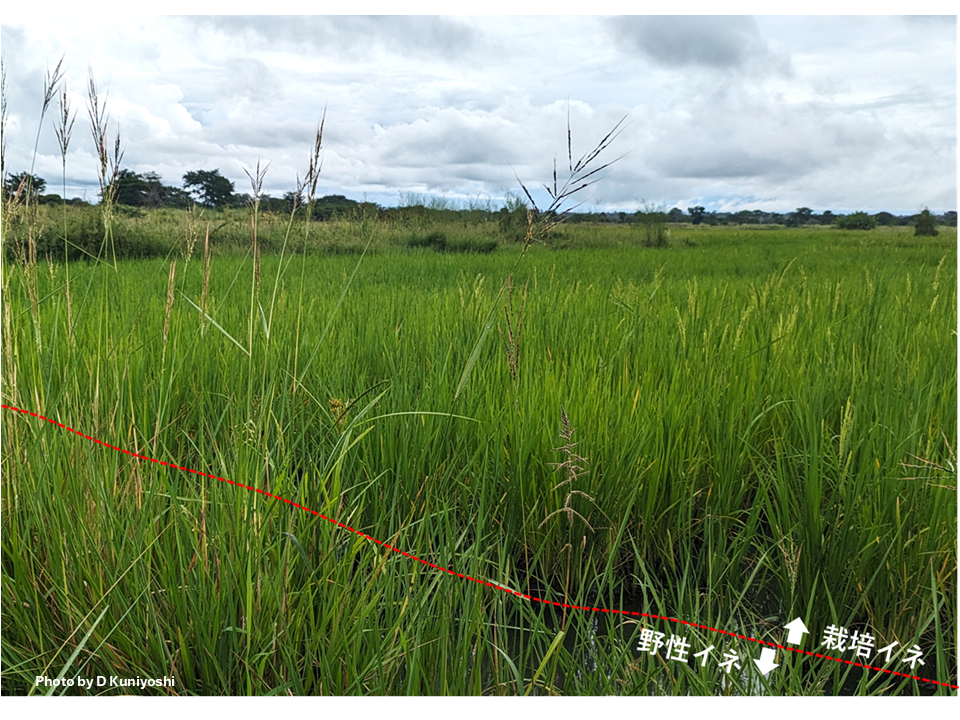
At the same time, Africa has its own independently domesticated rice species called African rice (Oryza glaberrima). Compared with Asian rice, African rice generally has lower yields and its taste is less widely preferred, so it is currently cultivated only in limited regions. However, because it was domesticated in Africa, it has several valuable traits, such as resistance to local diseases and the ability to grow in poor soils. In addition to African rice, several wild rice species are distributed across Africa. One of them, Oryza longistaminata (shown in the photograph), is a wild rice species known for its extremely vigorous growth.
If the vigorous growth of O. longistaminata and the disease resistance of African rice could be combined with the high yield and good eating quality of Asian rice, it may be possible to develop new rice varieties that are better adapted to African environments and produce large, tasty harvests. However, because these rice species are different, it is very difficult to produce hybrids between them. This difficulty is known as a hybridization barrier. My research focuses on overcoming this barrier and developing fertile hybrids that can produce rice grains. My goal is to create new rice varieties that combine the resilience of African rice relatives with the delicious taste of Asian rice.
*This article was edited and republished from Koho JIRCAS.
Contributor: KUNIYOSHI Daichi, Tropical Agriculture Research Front