



A new method to breed fertile interspecific hybrids between Asian and African rice species through manipulation of ploidy level
Related Research Project
Tropical crop genetic resources
Country
Japan
Description
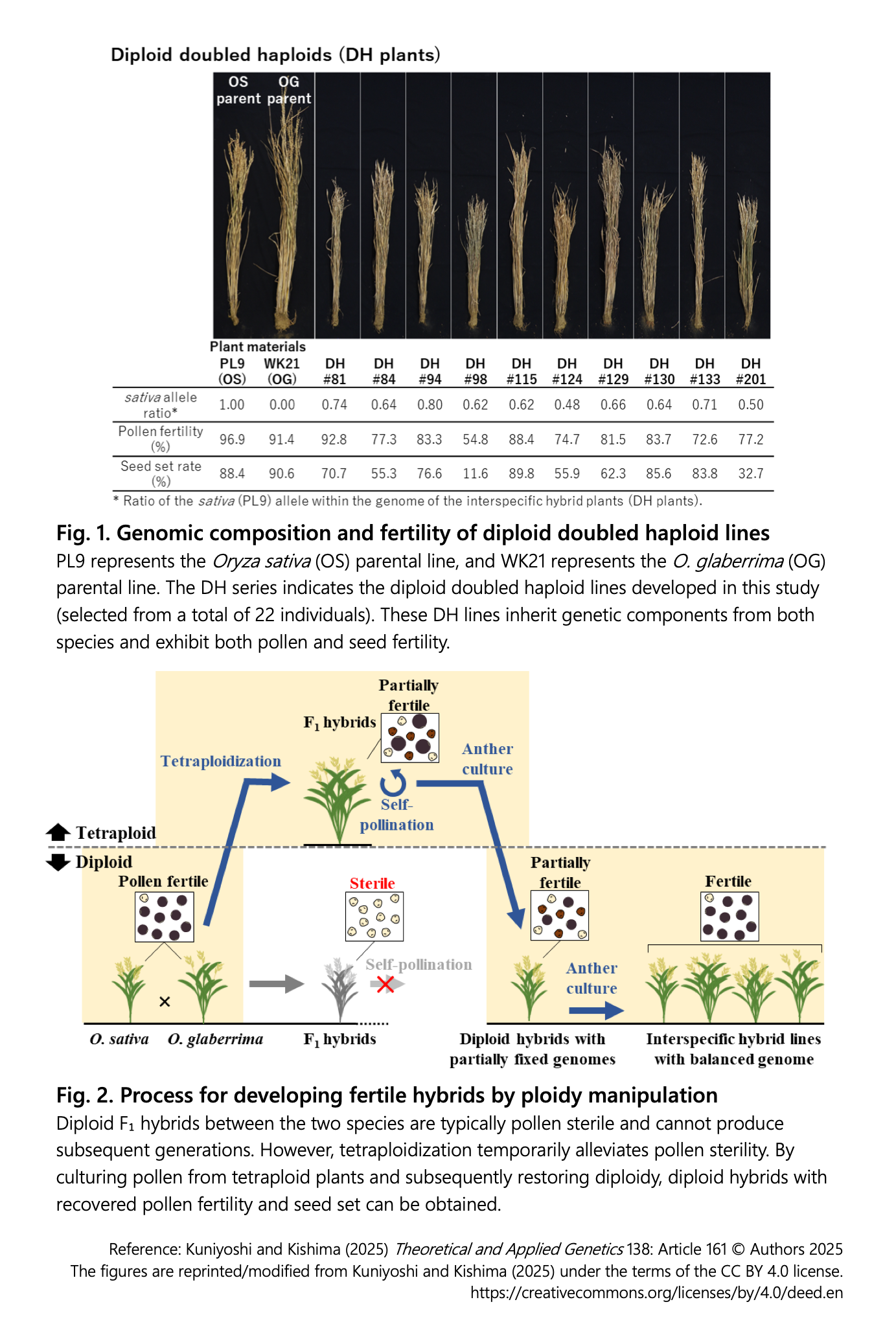
There are two cultivated rice species in the world: Asian rice (Oryza sativa) and African rice (O. glaberrima). Nearly all rice cultivated worldwide belongs to Asian rice. African rice, the other cultivated species, was independently domesticated in West Africa and exhibits valuable traits such as resistance to diseases, tolerance to environmental stresses, and competitiveness against weeds. These traits have attracted attention as genetic resources for breeding, particularly in regions facing climate change and the need for low-input agriculture. However, F₁ hybrids between Asian and African rice show severe pollen sterility, preventing seed production. To overcome this barrier, conventional approaches have relied on backcrossing to partially introgress African rice genes into Asian rice backgrounds. As a result, the proportion of the African rice genome in such lines is typically limited. In this study, we attempted to overcome hybrid sterility by manipulating ploidy in interspecific hybrids between Asian and African rice.
First, tetraploid lines of Asian and African rice were generated through colchicine treatment. Tetraploid interspecific F₁ hybrids were then produced by crossing these lines. By culturing microspores from these tetraploid hybrids, we obtained diploid interspecific hybrids with partially restored pollen fertility. Furthermore, by culturing microspores from these diploid hybrids, doubled haploid (DH) lines were generated (Fig. 1). These plants showed high fertility, with pollen fertility reaching up to 88.4% and seed fertility up to 89.8%, comparable to the parental lines (Fig. 1). Although the proportion of Asian- and African-type alleles varied among the doubled haploid lines, two lines (DH#124 and DH#201) exhibited nearly balanced genomic contributions from both species, representing balanced genetic compositions (Fig. 1). These results demonstrate that the combination of tetraploidization to alleviate hybrid sterility and subsequent diploid induction enables the production of fertile interspecific hybrids with balanced genomic compositions between Asian and African rice, which have been difficult to obtain using conventional approaches (Fig. 2).
The interspecific hybrids developed using this method retain a higher proportion of the African rice genome compared with conventional hybrids developed through backcrossing (e.g., NERICA lines). Therefore, they may carry complex traits derived from African rice. Future work will involve detailed evaluation of agronomic traits in these hybrid materials and identification of genes underlying useful traits. This approach is expected to contribute to the development of new Asian rice varieties with improved performance under low-input conditions, including enhanced weed competitiveness and adaptation to low-fertility soils.
Figure, table
- Research project
- Program name
- Term of research
-
FY2021-2025
- Responsible researcher
-
Kuniyoshi Daichi ( Tropical Agriculture Research Front )
ORCID ID0009-0004-2303-7161KAKEN Researcher No.: 70912559Kishima Yuji ( Hokkaido University )
- ほか
- Publication, etc.
-
Kuniyoshi and Kishima (2025) Theoretical and Applied Genetics 138: article number 161https://doi.org/10.1007/s00122-025-04901-3
- Japanese PDF
-
2025_C04_ja.pdf997.44 KB
- English PDF
-
2025_C04_en.pdf908.87 KB
* Affiliation at the time of implementation of the study.