



1538. The Changing Global Population Landscape
Related Research Program
Information
1538. The Changing Global Population Landscape
July 11 marked World Population Day. As of July 2026, the global population is estimated to have reached approximately 8.3 billion, and the long-term trend of population growth continues. However, a closer look at the data reveals that the world is entering a period of profound demographic transition.
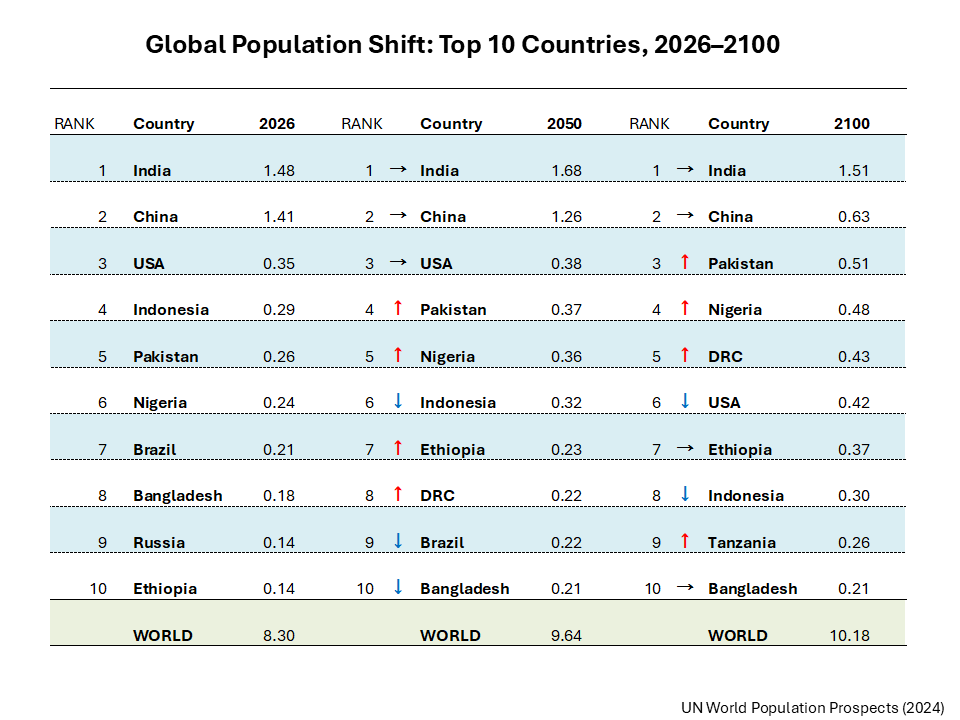
Today, India is the world's most populous country, with approximately 1.48 billion people, followed by China (1.41 billion) and the United States (350 million). Significant regional differences are also emerging in population growth patterns. Asia, home to nearly 4.8 billion people, remains the largest population center and accounts for more than half of the world's population. However, declining fertility rates are slowing population growth across many Asian countries. In contrast, Africa, with a population of about 1.5 billion, continues to experience the fastest population growth despite having only about one-third of Asia's population.
According to the United Nations' population projections (2024 Revision), the world's population is expected to reach approximately 9.6 billion by 2050. India, China, and the United States are projected to remain among the largest countries by population, while Pakistan and Nigeria are expected to rise significantly in the global rankings. Ethiopia and the Democratic Republic of the Congo are also projected to surpass 200 million inhabitants, highlighting the growing importance of Africa as a major driver of global population growth.
By 2100, the world's population is projected to stabilize at around 10.2 billion, but its composition will look markedly different from today. India is expected to remain the world's most populous country, while China's population is projected to decline to approximately 630 million, less than half of its current size. Meanwhile, Nigeria (about 480 million), the Democratic Republic of the Congo (430 million), Ethiopia (370 million), and Tanzania (260 million) are projected to rank among the world's ten most populous nations. These trends suggest that the center of global population growth will shift substantially from Asia toward Africa over the course of the 21st century.
Such demographic changes are not merely questions of population size. They are closely linked to critical development challenges, including food demand, job creation, education, urbanization, and climate change adaptation. In particular, the ability of countries in Africa and South Asia to invest in and harness their growing youth populations will play a key role in determining their future economic growth and social stability.
World Population Day provides an opportunity to view population not simply as a set of numbers, but as a reflection of broader social transformation and future development pathways. In a world where population growth and decline, ageing and youthfulness coexist, developing sustainable strategies tailored to the specific demographic realities of each region will become increasingly important.
References
United Nations, World Population Day 2026
https://www.un.org/en/observances/world-population-day
United Nations, World Population Prospects 2024
https://population.un.org/wpp/
Contributor: Miyuki Iiyama, Strategic Coordination Office