



Pick Up
1536. Smart Systems Breeding: A New Approach for Climate-Resilient Agriculture
Related Research Program
Information

1536. Smart Systems Breeding: A New Approach for Climate-Resilient Agriculture
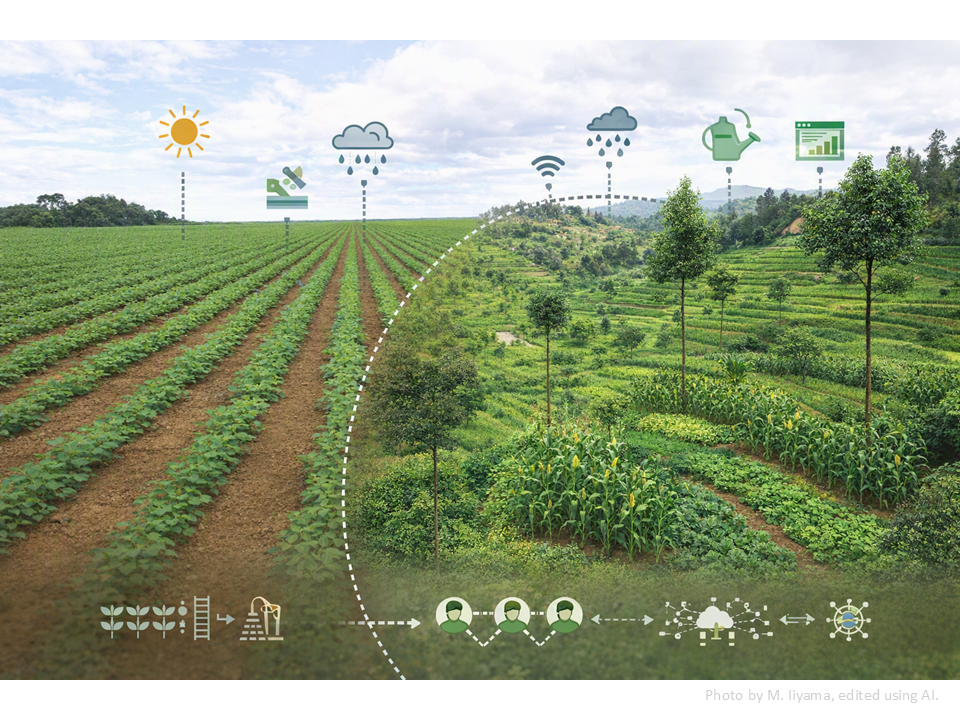
Plant breeding has played a vital role in improving agricultural productivity by developing high-yielding crop varieties. However, most modern breeding programs have been optimized for large-scale sole cropping systems, creating a gap between current breeding targets and the needs of sustainable, climate-resilient agriculture. In a recent Nature Food commentary, the authors propose a new framework called Smart Systems Breeding, designed to address this challenge. Rather than treating environmental variability as statistical noise to be averaged out, the framework views it as valuable information that can be used to develop and deploy crop varieties tailored to specific regions and growing conditions.
As climate change increases the frequency of droughts, heat waves, and other extreme weather events, diversified farming systems such as intercropping, variety mixtures, and agroforestry are gaining attention as effective strategies for improving agricultural resilience. Yet most commercial crop varieties have been bred for monoculture conditions and often fail to perform optimally in these more complex systems. Traits that are advantageous in sole cropping—such as aggressive competition for light, water, and nutrients—may actually be counterproductive in diversified systems, where complementary interactions among crops are critical for maximizing productivity and ecosystem benefits.
A key innovation of Smart Systems Breeding is its treatment of environmental variation as breeding information rather than unwanted noise. Conventional breeding programs typically combine data from multiple environments to identify broadly adapted varieties that perform well on average. However, in diversified agricultural systems, optimal performance depends on local climate, soil conditions, management practices, and interactions among different crop species and varieties. To capture this complexity, the authors propose a breeding framework that explicitly considers Genotype × Genotype × Environment × Management (G×G×E×M) interactions. The goal is to identify and develop crop varieties that are optimized not only for specific environments but also for particular crop combinations and management strategies.
A central component of this approach is the use of Living Labs, collaborative innovation platforms that bring together farmers, breeders, and researchers. Living Labs transform real farming environments into large-scale experimental networks where crop performance can be evaluated under practical production conditions. Data collected from farmers’ fields are fed directly back into research and breeding activities, creating a continuous learning cycle. Through decentralized on-farm evaluation, real-time environmental monitoring, predictive crop modeling, and AI-driven analytics, Smart Systems Breeding seeks to continuously improve recommendations on which varieties are best suited for specific regions, environmental conditions, and cropping systems.
The authors acknowledge that significant challenges remain. Farmer-generated data can be highly variable, and the interactions among genetics, environment, management, and crop partners are inherently complex. Successful implementation will therefore require robust data standards, advanced analytical tools, and strong incentives for farmer participation and data sharing. In Europe, for example, the economic value of crop varieties designed for diversified systems may depend on policy frameworks that reward environmental stewardship and ecosystem services, creating a stronger market for such innovations.
Ultimately, this commentary argues that the era of breeding varieties simply for broad adaptation may be reaching its limits. In a future shaped by climate uncertainty, agricultural success may depend on matching the right variety to the right environment, cropping system, and management practice. By combining advances in breeding, digital technologies, environmental intelligence, and farmer-led innovation, Smart Systems Breeding offers a promising pathway toward more resilient, productive, and sustainable agricultural systems.
Reference
Rezaei, E.E., Brinch-Pedersen, H., & Ewert, F. Smart breeding for diversified agricultural systems. Nature Food (2026). https://doi.org/10.1038/s43016-026-01382-5
Contributor: IIYAMA Miyuki, Strategic Coordination Office