



Pick Up
1447. Climate Change is Imminent in Coffee-Growing Regions
Related Research Program
Information
1447. Climate Change is Imminent in Coffee-Growing Regions
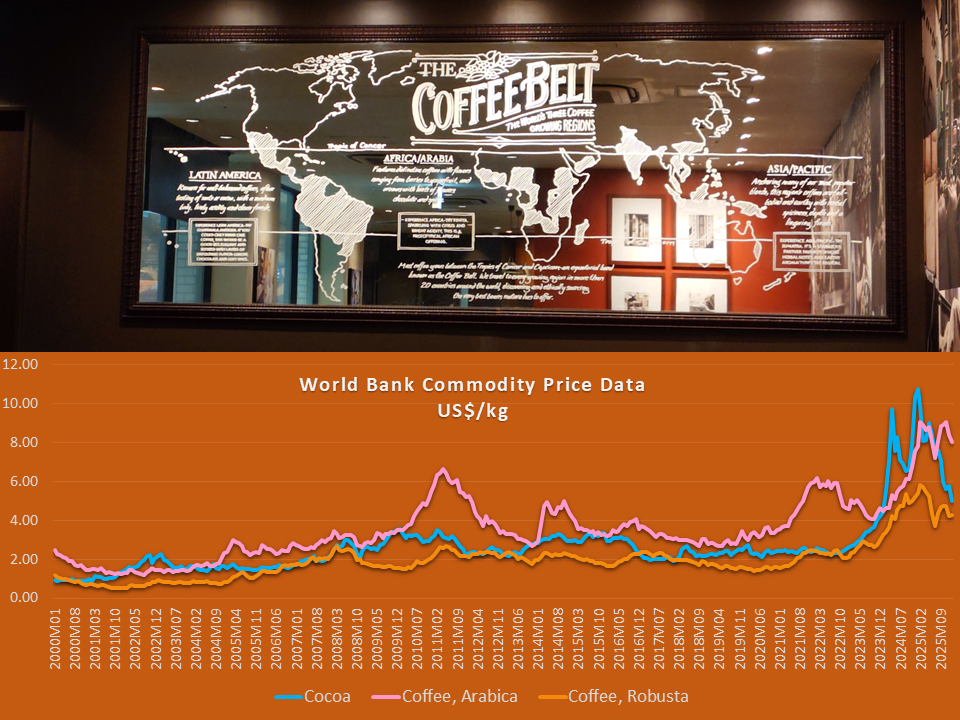
Coffee is one of the world's most popular beverages, with over 2 billion cups consumed daily. However, global coffee prices have been highly volatile in recent years, reaching record highs in December 2024 and February 2025. In the United States, import tariffs from Brazil (which supplies approximately one-third of the U.S. coffee beans) have also contributed to the rise in coffee prices over the past year. However, extreme weather in the world's coffee-producing regions (the "bean belt") is also at least partly responsible for the recent rise in coffee prices.
Climate Central, an independent research organization, has pointed out that human-induced climate change has led to an increase in extremely hot days each year in the world's major coffee-producing regions, potentially contributing to reduced yields and higher coffee prices.
Coffee trees thrive within specific temperature and rainfall ranges, and suboptimal conditions can negatively impact the yield and quality of coffee beans. According to Climate Central, temperatures above 30°C are "highly harmful" to Arabica, the dominant variety of coffee, which accounts for approximately 60-70% of global production, and "suboptimal" for Robusta, which accounts for the majority of the remainder. In its analysis, Climate Central estimated how many days per year temperatures would fall below 30°C if global warming were not present, and the actual number has exceeded that level.
Analysis shows that 25 countries, accounting for 97% of global coffee production, experienced an average of 47 more days of coffee-harming heat between 2021 and 2025. Five of these countries experienced an average of more than 144 days of coffee-harming heat per year. Without climate change, there would have been approximately 57 fewer days of such heat per year. Five countries, accounting for 75% of global coffee production (Brazil, Vietnam, Colombia, Ethiopia, and Indonesia), experienced an increase of 57 days of similar heat over the same period.
As climate change intensifies heat waves, alters rainfall patterns, and reduces arable land area, farmers are under pressure to adapt. Many coffee producers are smallholders whose livelihoods depend on coffee as a single crop, making them particularly vulnerable to the agricultural impacts of climate change.
Changing conditions threaten the amount of land available for coffee production. Without appropriate adaptation, land suitable for coffee cultivation could decrease by up to 50% by 2050. Climate change may alter the future extent of coffee cultivation. Current coffee-growing regions may become too warm over time, especially for the heat-sensitive Arabica variety, while areas previously unsuitable for coffee cultivation due to altitude or temperature may become more suitable in a warming world. This could lead to economic opportunities in new regions, but it could also lead to deforestation as farmers seek higher (cooler) land suitable for coffee cultivation.
Contributor: IIYAMA Miyuki, Information Program