



Pick Up
1437. Research Challenges for Stable Cacao Production
Related Research Program
Information
1437. Research Challenges for Stable Cacao Production
Cacao (Theobroma cacao L.) is native to South America and is primarily cultivated in a narrow area spanning 20 degrees north and south of the equator. Cocoa is primarily grown on small farms in West Africa, Southeast Asia, and Latin America, which have warm, humid tropical climates with abundant rainfall and short dry seasons, and is an important cash crop for tropical countries in these regions.
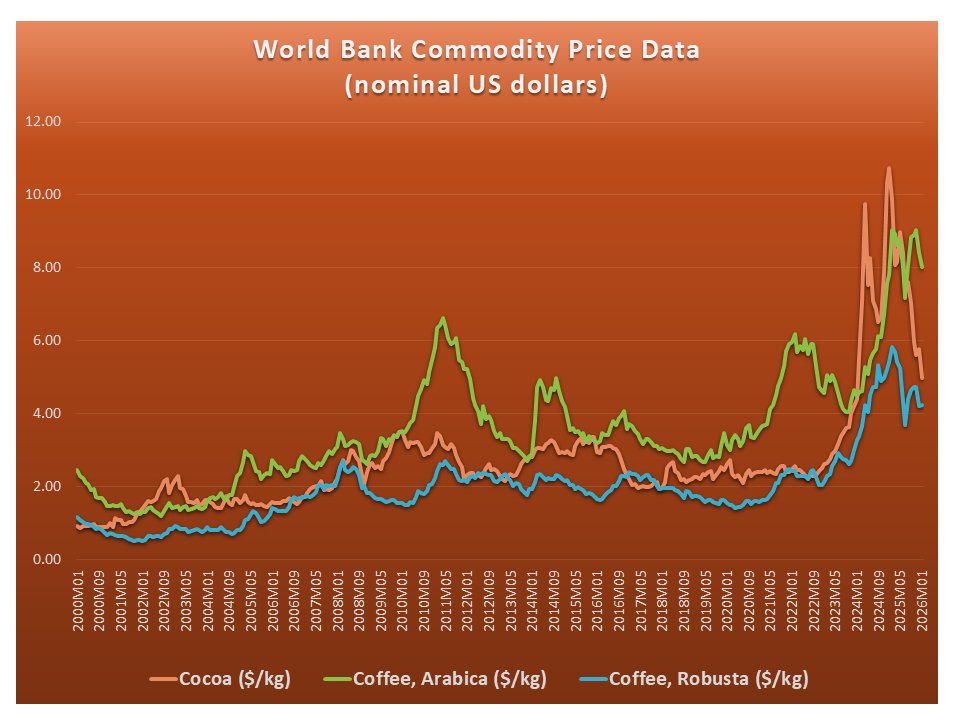
International cocoa prices have soared in recent years, and according to World Bank data, in January 2025 they hit an all-time high of $10.75 per kilogram, 2.5 times higher than in the same month last year and approximately four times higher than in the same month two years ago. International prices then began to decline, and by January 2026 they were down to $4.97 per kilogram, nearly half the value compared to the same month last year.
Regarding the recent rise in cocoa prices, it has been pointed out that in West Africa, which produces the majority of the world's cocoa supply, recent climate-related risks and outbreaks of pests such as cacao swollen shoot virus (CSSV) and black pod disease may have impacted small-scale producers' cocoa harvests. The UN article analyzes that supply-side shocks, combined with short-term, price-inelastic global cocoa demand, led to the price hike.
Heat and drought are both changes in optimal conditions. According to one study, recent future climate projections predict increased temperatures and decreased rainfall during periods critical for cocoa production in current cocoa-producing regions of West Africa. This raises concerns about negative impacts on yields due to increased temperatures, decreased rainfall, longer dry periods, and increased incidence of pests and diseases. High temperatures and drought are known to affect the physiology of cocoa plants through decreased photosynthesis and transpiration rates and changes in physiological processes related to the functioning of the photosynthetic system. Breeding for resistant varieties has been considered one way to increase cocoa yields. However, breeding for drought- and heat-tolerant, water-use-efficient, and high-yielding varieties has been limited by the inadequate use of proven breeding methods, a lack of information on the ecophysiology of cocoa, the long selection cycle of cocoa, and the heterozygosity of parental clones. Many botanists, however, recommend the provision of shade and the promotion of good agroforestry practices to ensure the environmental sustainability of cocoa production. Agroforestry practices have been shown to increase species diversity, reduce evapotranspiration, improve soil fertility, and protect cocoa from adverse effects such as strong winds. Meanwhile, companion trees in cocoa cultivation systems can have positive or negative effects depending on the species and whether they complement or compete in the root sphere. However, the large size and longevity of cocoa trees make ecophysiological research into cocoa challenging.
Another paper explored agroecosystem-level drivers of cacao swollen shoot virus (CSSV), a disease that has devastated cocoa production in West Africa. The paper analyzed data collected between 2021 and 2023 from 150 cocoa fields representing diverse cocoa growing conditions in Côte d'Ivoire. Clustering by similarity in CSSV incidence, meteorological conditions, soil properties, and agroforestry variables, the researchers examined associations at various scales. They found that low CSSV disease incidence was associated with increased frequency of extreme rainfall and decreased temperature variability. Conversely, high CSSV incidence was associated with a higher density of virus-hosting trees. Drawing on existing knowledge of epidemiology, vector biology, and cacao plant physiology, the paper concluded that plots with low disease incidence were primarily surrounded by non-host areas and potentially benefited from large-scale disease management strategies.
In summary, cacao is exposed to multiple risks that could negatively impact yields, including shifts in suitable habitat due to changes in temperature and precipitation, as well as shifts in weather patterns that favor pest and disease outbreaks due to climate change. Existing research suggests the need for cross-disciplinary collaboration to address the challenges of developing varieties and cultivation methods to address these risks, as well as for pest and disease management at the agroecosystem level, in order to ensure stable cacao production.
(References)
Mensah, E.O. et al. (2024). Cocoa Under Heat and Drought Stress. In: Olwig, M.F., Skovmand Bosselmann, A., Owusu, K. (eds) Agroforestry as Climate Change Adaptation. Palgrave Macmillan, Cham. https://doi.org/10.1007/978-3-031-45635-0_2
A. Dumont, et al., Associations between scale-dependent agroecosystem factors and cocoa swollen shoot virus incidence in Côte d’Ivoire, Agriculture, Ecosystems & Environment, Volume 393, 2025. https://doi.org/10.1016/j.agee.2025.109851.
Contributor: IIYAMA Miyuki, Information Program