



Current Status and Prospects for Perennial Crop Breeding
JARQ : Japan Agricultural Research Quarterly
| ISSN | 00213551 |
|---|---|
| 書誌レコードID(総合目録DB) | AA0068709X |
本文フルテキスト
jarq60-2_127-136.pdf996.16 KB
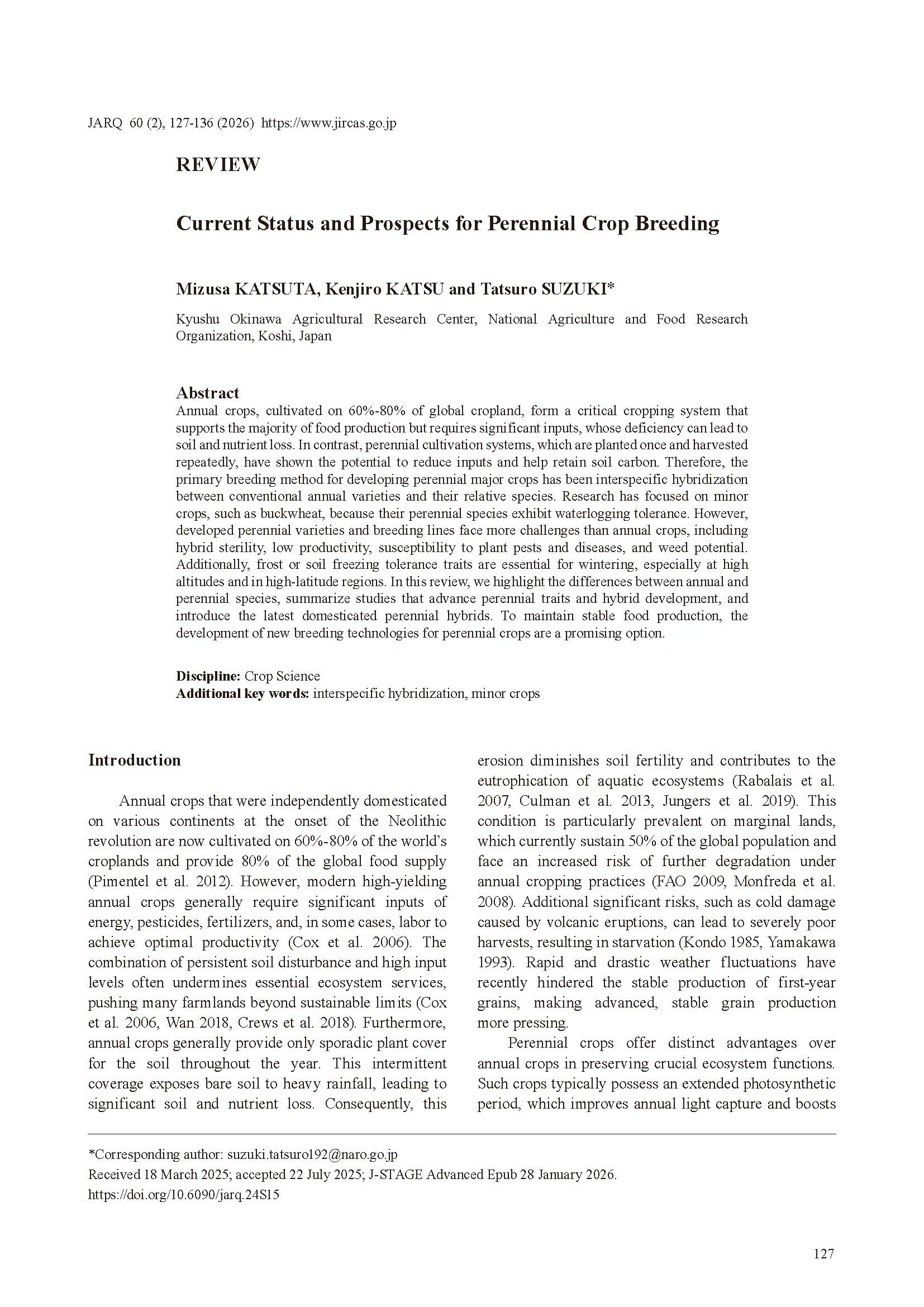
Annual crops, cultivated on 60%-80% of global cropland, form a critical cropping system that supports the majority of food production but requires significant inputs, whose deficiency can lead to soil and nutrient loss. In contrast, perennial cultivation systems, which are planted once and harvested repeatedly, have shown the potential to reduce inputs and help retain soil carbon. Therefore, the primary breeding method for developing perennial major crops has been interspecific hybridization between conventional annual varieties and their relative species. Research has focused on minor crops, such as buckwheat, because their perennial species exhibit waterlogging tolerance. However, developed perennial varieties and breeding lines face more challenges than annual crops, including hybrid sterility, low productivity, susceptibility to plant pests and diseases, and weed potential. Additionally, frost or soil freezing tolerance traits are essential for wintering, especially at high altitudes and in high-latitude regions. In this review, we highlight the differences between annual and perennial species, summarize studies that advance perennial traits and hybrid development, and introduce the latest domesticated perennial hybrids. To maintain stable food production, the development of new breeding technologies for perennial crops are a promising option.
| 刊行年月日 | |
|---|---|
| 作成者 | Mizusa KATSUTA Kenjiro KATSU Tatsuro SUZUKI |
| 著者キーワード | interspecific hybridization minor crops |
| 公開者 | Japan International Research Center for Agricultural Sciences |
| 受付日 | 2025-03-18 |
| 受理日 | 2025-07-22 |
| オンライン掲載日 | |
| 国立情報学研究所メタデータ主題語彙集(資源タイプ) | Journal Article |
| 巻 | 60 |
| 号 | 2 |
| 開始ページ | 127 |
| 終了ページ | 136 |
| DOI | 10.6090/jarq.24S15 |
| 言語 | eng |