



Pick Up
1526. Heatwave Expands Across Europe: Copernicus Observations Highlight Elevated Land Surface Temperatures and Concerns over Ground-Level Ozone
Related Research Program
Information
1526. Heatwave Expands Across Europe: Copernicus Observations Highlight Elevated Land Surface Temperatures and Concerns over Ground-Level Ozone
In late June 2026, Western Europe experienced an intense heatwave, particularly affecting France and Spain. According to the French national meteorological service, 23 June was the hottest day recorded since observations began in 1947. In Spain, high-temperature warnings were issued across several northern regions.
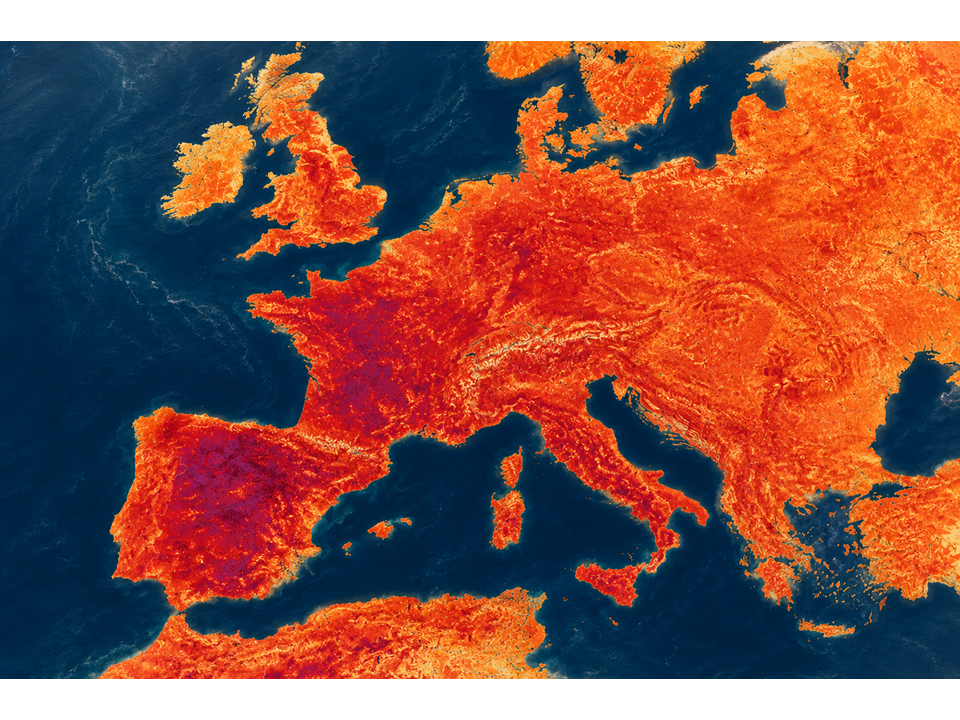
Data acquired by the Copernicus Sentinel-3 satellites on 23 June 2026 showed extensive areas with Land Surface Temperatures (LST) exceeding 50°C across central and southern France and northern Spain. It should be noted that land surface temperature represents the temperature of the ground surface and differs from air temperature, although the two are generally correlated.
Meanwhile, the European Environmental Bureau (EEB) reported that the heatwave has been accompanied by elevated ground-level ozone concentrations across parts of Europe, resulting in episodes of photochemical smog. According to the EEB, ground-level ozone is formed through photochemical reactions involving precursor gases such as methane and nitrogen oxides (NOx) in the presence of sunlight. Elevated ozone concentrations are associated with adverse effects on human health as well as damage to agricultural crops.
The EEB further notes that ozone pollution was associated with an estimated 70,000 premature deaths and approximately €2 billion in crop losses across Europe in 2022. It also reports that in 2025, more than 85 percent of air-quality monitoring stations in the European Union exceeded the health protection target for ozone.
Based on these observations, the EEB argues that reducing methane emissions from agriculture would contribute both to lowering ground-level ozone concentrations and to mitigating climate change, and therefore recommends introducing methane reduction targets that include the agricultural sector.
Taken together, these reports indicate that the recent European heatwave represents more than an episode of extreme heat. It also illustrates the interconnected impacts of climate change on air quality, agriculture, and human health. The combined use of satellite observations and atmospheric monitoring provides valuable information for understanding these multiple dimensions of climate-related risks.
References
European Union. Heatwave affecting Western Europe in the third decade of June 2026. Copernicus Sentinel-3 Image of the Day. 24 Jun 2026.
European Environmental Bureau (EEB). Heatwaves fuel dangerous smog across Europe as civil society calls for methane cuts. 22 June 2026.
Contributor: IIYAMA Miyuki, Strategic Coordination Office