



Characteristics of Potato Starch: Phosphorus Content, Physicochemical Properties, and Digestibility
JARQ : Japan Agricultural Research Quarterly
| ISSN | 00213551 |
|---|---|
| 書誌レコードID(総合目録DB) | AA0068709X |
本文フルテキスト
jarq60-3_205-213.pdf1.17 MB
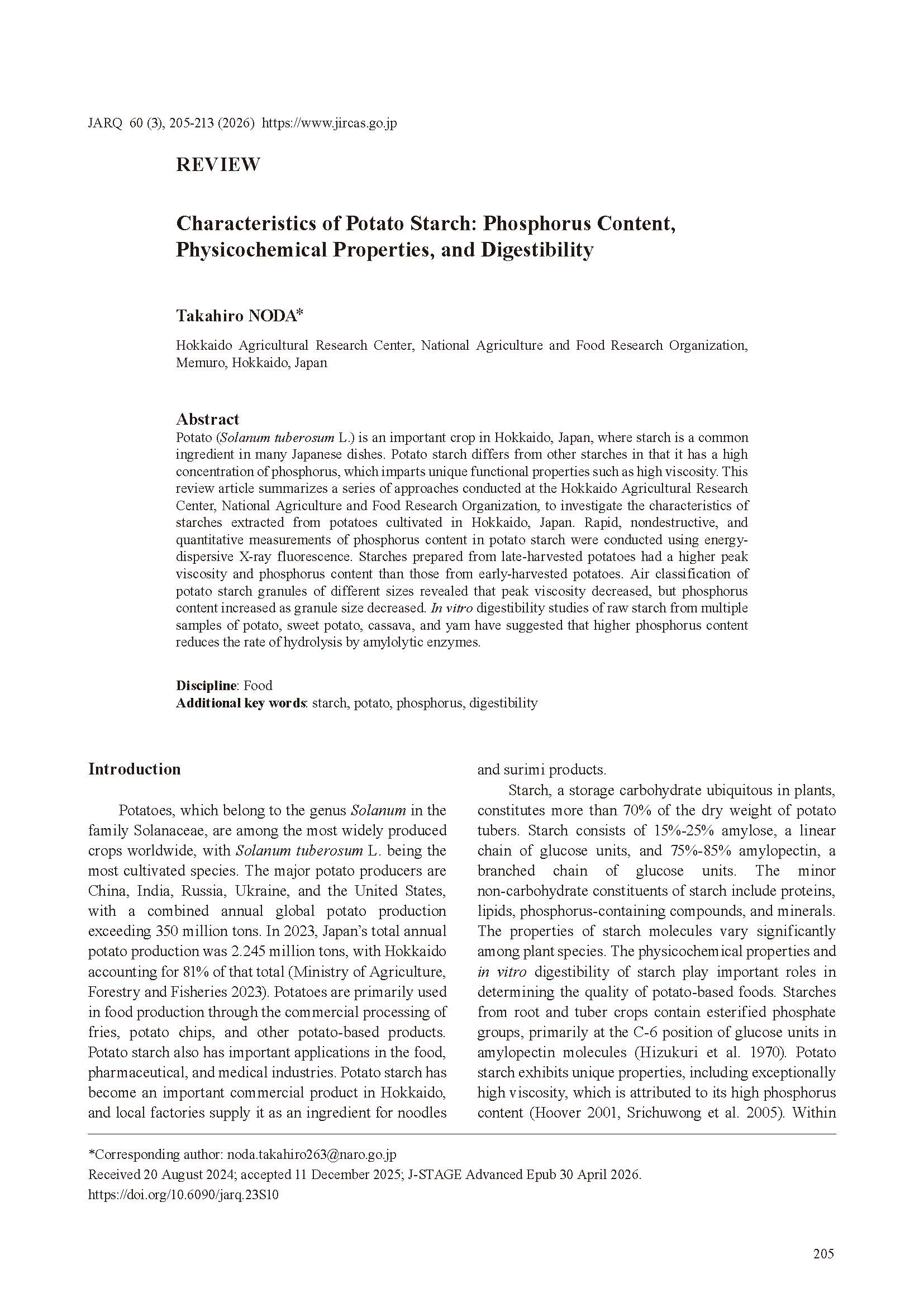
Potato (Solanum tuberosum L.) is an important crop in Hokkaido, Japan, where starch is a common ingredient in many Japanese dishes. Potato starch differs from other starches in that it has a high concentration of phosphorus, which imparts unique functional properties such as high viscosity. This review article summarizes a series of approaches conducted at the Hokkaido Agricultural Research Center, National Agriculture and Food Research Organization, to investigate the characteristics of starches extracted from potatoes cultivated in Hokkaido, Japan. Rapid, nondestructive, and quantitative measurements of phosphorus content in potato starch were conducted using energy-dispersive X-ray fluorescence. Starches prepared from late-harvested potatoes had a higher peak viscosity and phosphorus content than those from early-harvested potatoes. Air classification of potato starch granules of different sizes revealed that peak viscosity decreased, but phosphorus content increased as granule size decreased. In vitro digestibility studies of raw starch from multiple samples of potato, sweet potato, cassava, and yam have suggested that higher phosphorus content reduces the rate of hydrolysis by amylolytic enzymes.
| 刊行年月日 | |
|---|---|
| 作成者 | Takahiro NODA |
| 著者キーワード | starch potato phosphorus digestibility |
| 公開者 | Japan International Research Center for Agricultural Sciences |
| 受付日 | 2024-08-20 |
| 受理日 | 2025-12-11 |
| オンライン掲載日 | |
| 国立情報学研究所メタデータ主題語彙集(資源タイプ) | Journal Article |
| 巻 | 60 |
| 号 | 3 |
| 開始ページ | 205 |
| 終了ページ | 213 |
| DOI | 10.6090/jarq.23S10 |
| 言語 | eng |