The 7th Meeting of the International Scientific Advisory Board for Strategy “MIDORI”
The 7th Meeting of the International Scientific Advisory Board for Strategy “MIDORI”
Based on the Strategy for Sustainable Food Systems “MIDORI” formulated in May 2021, the Ministry of Agriculture, Forestry and Fisheries (MAFF) initiated the project “Accelerating application of agricultural technologies which enhance production potentials and ensure sustainable food systems in the Asia-Monsoon region” in FY2022. The goal was to accelerate the application of technologies that promote climate change mitigation and sustainable agriculture in the Asia-Monsoon region. JIRCAS conducts the project under the name “Green Asia” (project acronym).
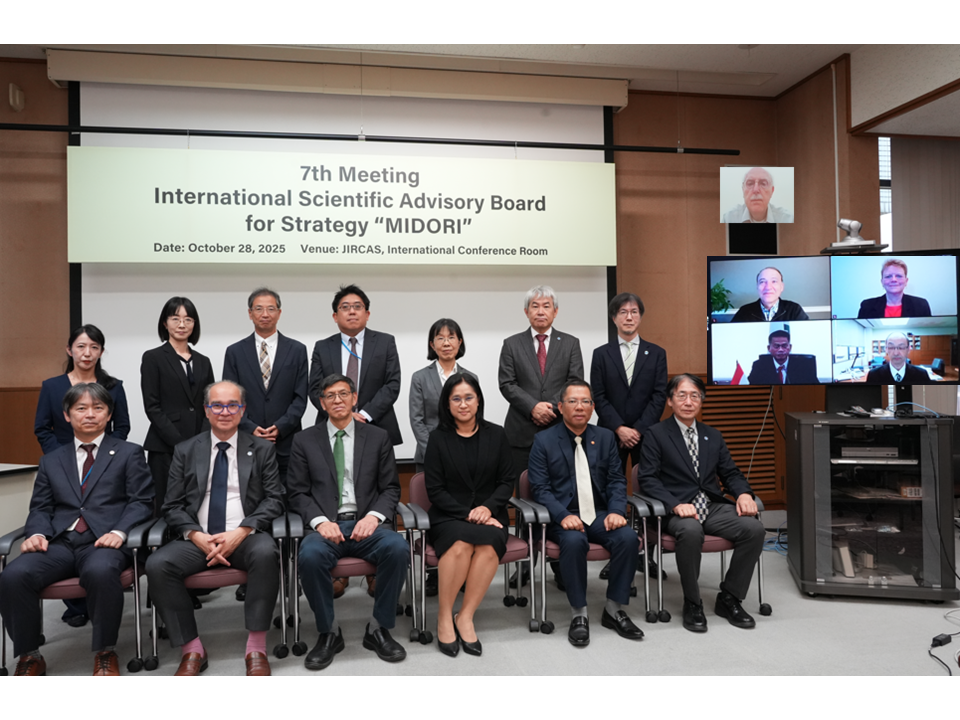
On October 28, the 7th meeting of the International Scientific Advisory Board was held in a hybrid format at the JIRCAS Headquarters in Tsukuba City, Japan. At the beginning of the meeting, opening remarks were delivered by Mr. Koyama, President of JIRCAS, and Mr. Sato, Deputy Director-General of the Agriculture, Forestry and Fisheries Research Council Secretariat of MAFF. MAFF then explained the implementation status of the MIDORI Strategy and the revised “ASEAN-Japan MIDORI Cooperation Plan.”
The Secretariat of the International Scientific Advisory Board reported that the “Technology Catalog Contributing to Production Potential and Sustainability in the Asia-Monsoon Region Ver.4.0” was released in early October. In addition, toward the finalization of the project, an overview of draft reports was presented, covering the overall activities of Green Asia, intermittent irrigation technology, BNI-enabled wheat, and the utilization of an international differential system for controlling rice blast disease.
After that, MAFF provided explanations of the “Global MIDORI Cooperation Plan” and the “Initiative for Net-zero compatible with Food security through INternational expansion of Innovative TechnologY” (MIDORI∞INFINITY), aiming to facilitate climate investment in the agriculture, forestry, and food sectors, expand market opportunities, and present the next project plan after Green Asia. In addition, the Secretariat of the Advisory Board invited comments on considerations for the next project plan from board members and observers, including the Director of the UN Food Systems Coordination Hub and the Head of the Food, Agriculture, and Forestry Division of the ASEAN Secretariat.
The advisory board and other participants expressed the following views:
- Welcomed the next project plan and encouraged ambitious efforts. In doing so, they recommended moving beyond an approach focused solely on productivity to embrace a “food systems approach” that incorporates trade and market linkages as well as public-private partnerships.
- Suggested that the Technology Catalog be more widely shared with local counterparts in the Asia-Monsoon region and that demonstration trials be expanded.
- Recommended considering incubation opportunities for youth- and women-led businesses.
- Noted that when making proposals to ASEAN countries, introducing them through the sector-specific ASEAN Working Groups on R&D and Technology would help identify the most promising candidate countries.
Finally, Dr. Yanagihara, Vice President of JIRCAS, delivered closing remarks.