



Genetic distinctiveness of Japanese native Saccharum spontaneum and its importance as a genetic resource for sugarcane improvement
Related Research Project
Tropical crop genetic resources
Country
Japan
Description
Sugarcane (Saccharum L.) is a globally important crop used not only for sugar production but also for bioenergy production to realize a low-carbon society. However, sugarcane production is increasingly threatened by climate change, which is expected to cause greater instability in yields and productivity. To address this issue, further improvement of sugarcane is required; however, breeding has been constrained by the limited genetic diversity of existing cultivars and breeding materials. To overcome these challenges, it is essential to expand genetic diversity and introduce valuable traits by effectively utilizing untapped wild genetic resources.
Saccharum spontaneum is widely distributed across tropical and subtropical regions of Asia, including both continental and island areas, and possesses a wide range of useful traits such as stress tolerance and excellent ratooning ability. Modern sugarcane cultivars have been developed through interspecific hybridization between S. officinarum and S. spontaneum. However, despite the recognized importance of S. spontaneum, there has been limited information on the specific contributions of its germplasm to the genetic background of modern cultivars.
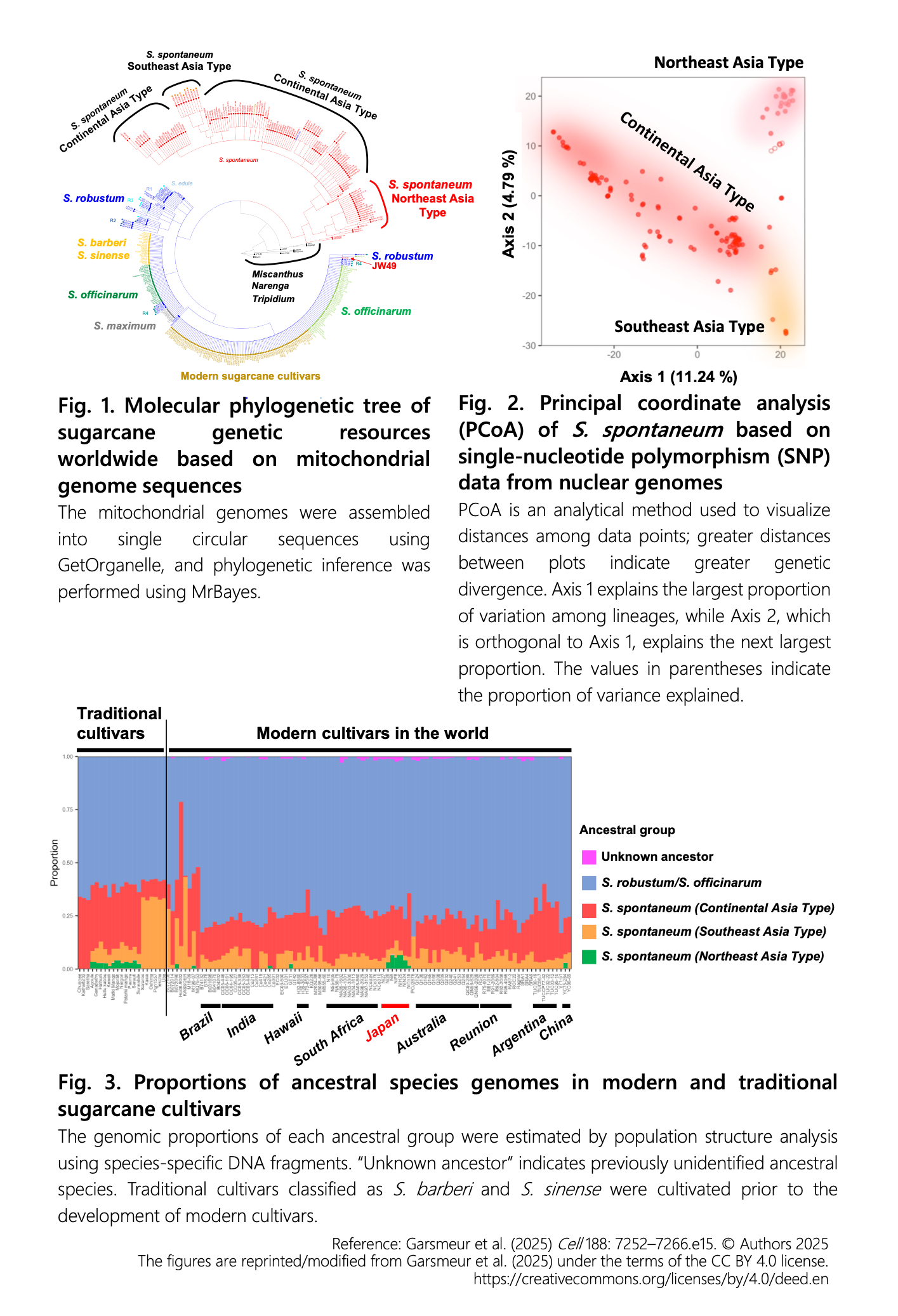
In this study, we analyzed the genetic diversity of a total of 390 sugarcane genetic resources collected from all over the world. These included 135 S. spontaneum (including four Japanese native accessions), as well as S. robustum (45 accessions), S. barberi (15 accessions), S. sinense (6 accessions), and S. maximum (8 accessions), along with 96 modern cultivars (including seven Japanese cultivars).
The analysis revealed that S. spontaneum can be classified into three groups based on geographic distribution: Continental Asia Type (e.g., India and Thailand), Southeast Asia Type (e.g., Indonesia and Oceania), and Northeast Asia Type (e.g., Japan, China, and Taiwan) (Figs. 1 and 2). Furthermore, the S. spontaneum genomes of the Continental and Southeast Asia Types have made substantial contributions to the genetic background of modern sugarcane cultivars worldwide. In contrast, the contribution of the Northeast Asia Type was extremely limited and detected only in a small number of modern cultivars from Japan and China (Fig. 3). These findings indicate that S. spontaneum from Northeast Asia, particularly Japanese native accessions and Japanese cultivars with the genome, has significant importance and potential for expanding genetic diversity and introducing novel traits in future sugarcane breeding.
Figure, table
- Research project
- Program name
- Term of research
-
FY2022-2025
- Responsible researcher
-
Teraiima Yoshifumi ( Tropical Agriculture Research Front )
- ほか
- et al.
- Publication, etc.
-
Garsmeur et al. (2025) Cell 188(25): 7252-7266https://doi.org/10.1016/j.cell.2025.09.017
- Japanese PDF
-
2025_C03_ja.pdf736.22 KB
- English PDF
-
2025_C03_en.pdf625.24 KB
* Affiliation at the time of implementation of the study.