



Development of a low-cost intermediate nursery system for tropical oyster aquaculture
Related Research Project
Ecosystem approach to aquaculture
Country
Malaysia
Description
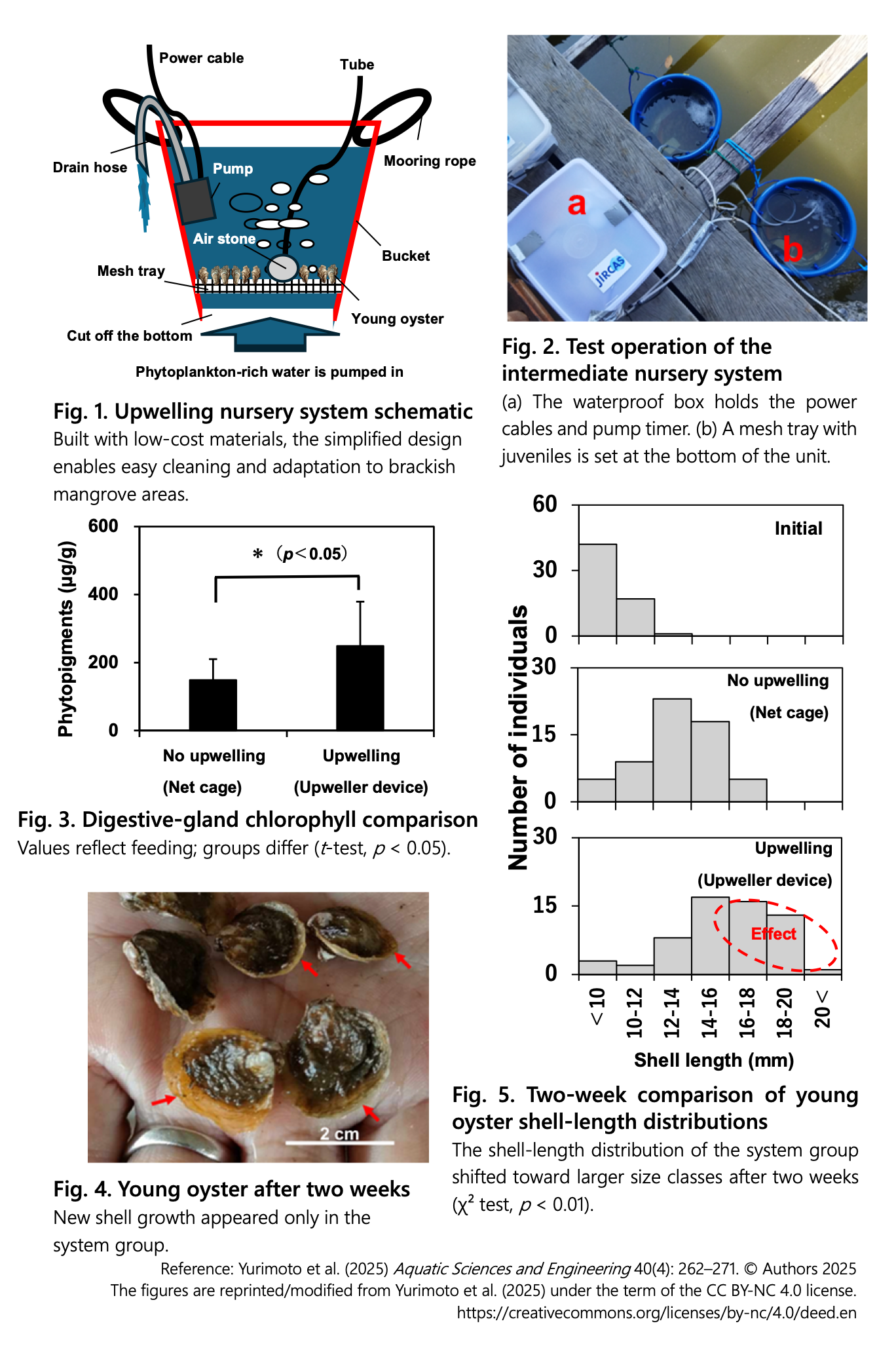
High mortality of early-stage oyster spat remains a central obstacle to the growth of tropical oyster aquaculture, particularly in mangrove-influenced estuaries where environmental fluctuations, hypoxia, turbidity, and biofouling impose severe stress on juvenile oysters. Conventional solutions such as land-based tank rearing and large commercial floating upweller system units can stabilize early growth but are prohibitively expensive and labor-intensive for the small-scale farmers who dominate production in regions like Peninsular Malaysia. To provide a practical alternative, this study developed a low-cost, forced-flow nursery upweller that can be constructed entirely from commercially available materials—including a plastic bucket, mesh trays, and a compact submersible pump—while remaining lightweight, portable, and easy to maintain under field conditions.
A 14‑day field experiment in the upper Merbok estuary compared three rearing methods—a conventional net cage, a net cage with aeration, and the improved upweller system. During the trial, water temperatures were 30–32°C, salinity stayed around 24–25, and chlorophyll‑a levels reached up to 27 μg/L, providing optimal feeding conditions. The upweller ran stably without pump clogging despite moderate biofouling, and its simple design enabled easy lifting, cleaning, and reinstallation by a person. Growth results showed advantages: 80% of oysters in the upweller formed new shell edges, compared with 47% and 57% in the other treatments. Additionally, 23% of oysters in the upweller exceeded 18 mm in shell length, and digestive‑gland phytopigments were significantly higher (p < 0.05), indicating enhanced feeding efficiency under forced water exchange.
These findings demonstrate that the forced-flow upweller provides a highly effective, accessible, and scalable solution for the intermediate nursery phase in tropical estuarine aquaculture. By stabilizing early growth and reducing mortality risk, the system helps lower seed costs and improves income reliability for small-scale farmers, while also reducing labor demands through simplified maintenance. Although the device currently requires a power source, future improvements—including solar-powered operation and potential integration with IoT-based environmental monitoring—could further enhance operational resilience in dynamic mangrove ecosystems. Overall, the developed nursery upweller represents a promising technology that supports sustainable expansion of oyster aquaculture in Southeast Asia and other tropical estuarine regions.
Figure, table
- Research project
- Program name
- Term of research
-
FY2021-2025
- Responsible researcher
-
Yurimoto Tatsuya ( Fisheries Division )
ORCID ID0000-0002-7275-064XKAKEN Researcher No.: 90372002 - ほか
- Publication, etc.
-
Yurimoto T., et al. (2025) Improvement of the Nursery Upweller for Young Oysters in Tropical Mangrove Estuaries. Aquatic Sciences and Engineering 40(4): 262–271https://doi.org/10.26650/ASE.2025.1738425
- Japanese PDF
-
2025_B08_ja.pdf1.14 MB
- English PDF
-
2025_B08_en.pdf707.73 KB
* Affiliation at the time of implementation of the study.