



A simple photosynthesis measurement device using a compact, low-cost microcomputer and CO2 sensor
Related Research Project
Tropical crop genetic resources
Country
Japan
Description
Leaf photosynthetic rate is a growth assessment indicator used in many contexts within the field of plant science. The assimilation chamber method is one of its measurement techniques, and commercially available portable measuring devices were first introduced approximately 40 years ago. Today, their successor models are the mainstream choice due to advantages such as superior measurement accuracy and speed. On the other hand, the high cost (ranging from several million to over 10 million yen, and subject to further increases due to social conditions and exchange rate fluctuations) is the primary concern preventing a wide range of users (researchers, producers, educators, etc.) from utilizing photosynthesis measurement devices.
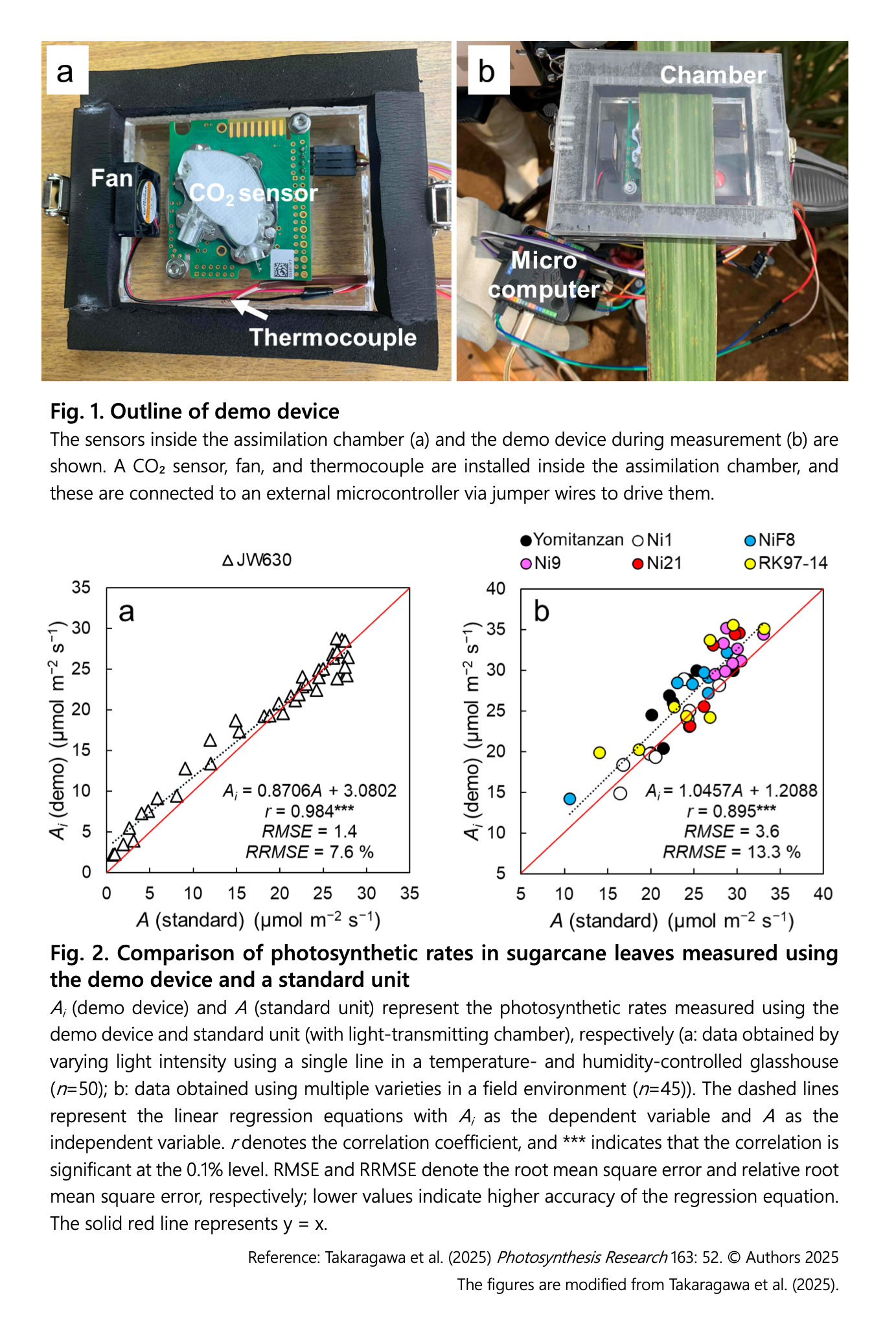
We developed a prototype closed-system photosynthesis measurement system (hereinafter referred to as the “demo device”) that incorporates an inexpensive CO₂ sensor into a custom-built assimilation chamber and is controlled and recorded by a small microcomputer (Fig. 1a,b). The demo device can be built inexpensively with material costs of approximately 30,000 yen. When the measurement performance of the demo device was compared to that of a standard unit using sugarcane leaves, a significant correlation between the measured values was observed in both cases: when light intensity was varied using artificial light sources in a temperature- and humidity-controlled room (Fig. 2a) and when multiple varieties were measured under natural outdoor light conditions (Fig. 2b). The accuracy of a simple linear regression model using the photosynthesis rate measurements from these devices was sufficiently high with low values of root mean square error under all conditions, highlighting the high measurement accuracy of the demo device.
Our results indicate that as photosynthesis measurements become more affordable and accessible, photosynthesis research will become more accessible to many researchers with limited budgets, thereby stimulating research in related fields. These results do not guarantee performance equivalent to that of the standard unit; it is recommended that the demo device and the standard unit be used for different purposes as appropriate. Since inexpensive CO₂ sensors may vary in performance and durability, it is necessary to verify their performance under atmospheric CO₂ conditions or known CO₂ concentrations as appropriate. To apply this system to the evaluation of multiple samples (high-throughput phenotyping), such as genetic resources or hybrid populations, improvements to the data recording system (e.g., from wired to wireless) and the measurement system (e.g., from closed to open) should be considered.
Figure, table
- Research project
- Program name
- Term of research
-
FY2022-2023
- Responsible researcher
-
Takaragawa Hiroo ( Tropical Agriculture Research Front )
ORCID ID0000-0002-6238-1078KAKEN Researcher No.: 70851260Asahi Tomoki ( University of the Ryukyus )
Mitsuoka Muneshi ( University of the Ryukyus )
KAKEN Researcher No.: 60437770Taira Eizo ( University of the Ryukyus )
KAKEN Researcher No.: 20433097Kawamitsu Yoshinobu ( University of the Ryukyus )
KAKEN Researcher No.: 20192552 - ほか
- Publication, etc.
-
Takaragawa et al. (2025) Photosynthesis Research 163: 52https://doi.org/10.1007/s11120-025-01170-5
- Japanese PDF
-
2025_C01_ja.pdf693.16 KB
- English PDF
-
2025_C01_en.pdf1.56 MB
* Affiliation at the time of implementation of the study.