



Long-term preservation of genetic resources in the giant freshwater prawn by germ cell cryopreservation
Related Research Project
Ecosystem approach to aquaculture
Description
Cryopreservation of germ cells is a promising approach for preserving the entire genetic background of crustaceans, for which cryopreservation of gametes and early embryos remains difficult. In aquaculture, repeated use of limited broodstock lines over time can reduce genetic diversity and increase vulnerability to disease, making the development of reliable genetic resource preservation technologies increasingly important for sustainable production.
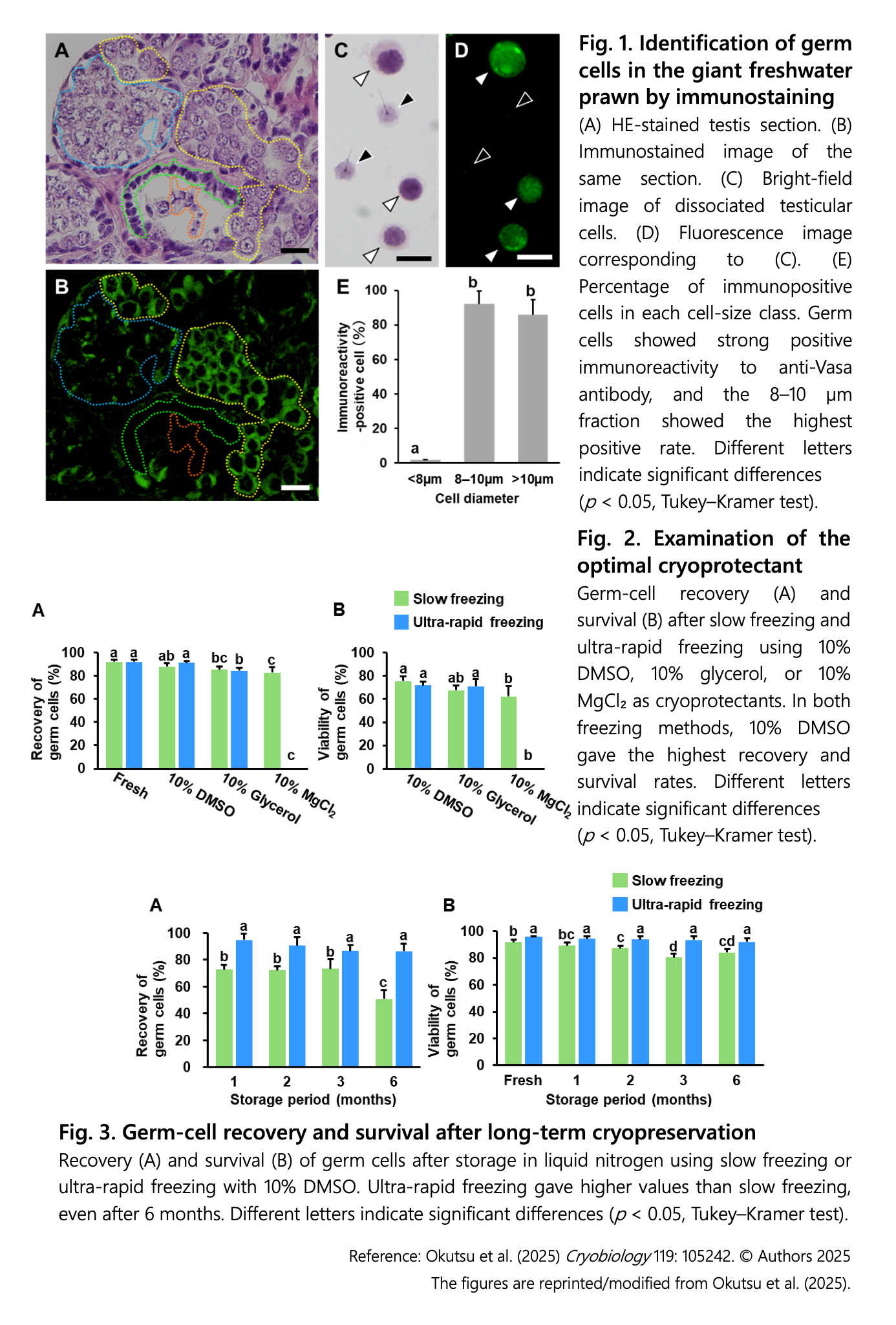
The giant freshwater prawn (Macrobrachium rosenbergii), native to Southeast Asia, is one of the most economically important freshwater aquaculture species. However, repeated use of limited lines raises concern about future loss of genetic diversity. To address this issue, this study developed a method for cryopreserving germ cells of the giant freshwater prawn and evaluated suitable cryoprotectants and freezing conditions for long-term preservation.
The study showed that germ cells of the giant freshwater prawn could be identified using a commercially available anti-Vasa antibody and efficiently selected on the basis of cell diameter (8–10 µm) alone. Among the cryoprotectants tested, 10% dimethyl sulfoxide (DMSO) gave better recovery and survival rates than glycerol or magnesium chloride. In addition, ultra-rapid freezing outperformed slow freezing in maintaining higher recovery and survival rates during long-term storage. When combined with 10% DMSO, ultra-rapid freezing maintained high recovery and survival rates even after more than 6 months of storage in liquid nitrogen.
This is the first report establishing germ-cell cryopreservation in freshwater prawns. The results indicate that genetic resources of the giant freshwater prawn can be preserved long term in a space-saving manner without continuous maintenance of live individuals. The same cryopreservation condition was also effective in marine penaeid shrimp reported previously, suggesting broader applicability to crustacean germ cells. Although direct regeneration of individuals from cryopreserved germ cells has not yet been achieved, further development of related technologies, such as germ-cell transplantation, which has already been applied in finfish species, will be necessary. This study therefore provides a foundation for future breeding and conservation of valuable aquaculture lines.
Figure, table
- Research project
- Program name
- Term of research
-
FY2018-2023
- Responsible researcher
-
Okutsu Tomoyuki ( Fisheries Division )
ORCID ID0009-0003-7607-7848KAKEN Researcher No.: 40456322Rakbanjong Natthida ( Prince of Songkla University )
Wonglapsuwan Monwadee ( Prince of Songkla University )
Miwa Misako ( Tokyo University of Marine Science and Technology )
Shikina Shinya ( National Taiwan Ocean University )
- ほか
- Publication, etc.
-
Okutsu et al. (2025) Cryobiology 119: 105242https://doi.org/10.1016/j.cryobiol.2025.105242
- Japanese PDF
-
2025_B05_ja.pdf1.5 MB
- English PDF
-
2025_B05_en.pdf1 MB
* Affiliation at the time of implementation of the study.