



Visualizing the effect of production and consumer efforts on nitrogen load reduction using the food nitrogen footprint concept
Related Research Project
Yama-Sato-Umi agroecosystem connectivity
Country
Japan
Description
Issues related to reactive nitrogen (Nr) continue to increase and have exceeded planetary boundaries. Both production- and consumer-level efforts can mitigate Nr loads and inputs. However, only independent evaluations of these efforts have been performed thus far, and the lack of comprehensive evaluations has hindered further reductions in Nr loads and inputs. Therefore, in this study, we applied the food nitrogen footprint to Ishigaki Island, Japan, and evaluated both direct (on-island) and indirect (overseas-related, i.e., imported food/feed production) Nr loads and inputs within the food system.
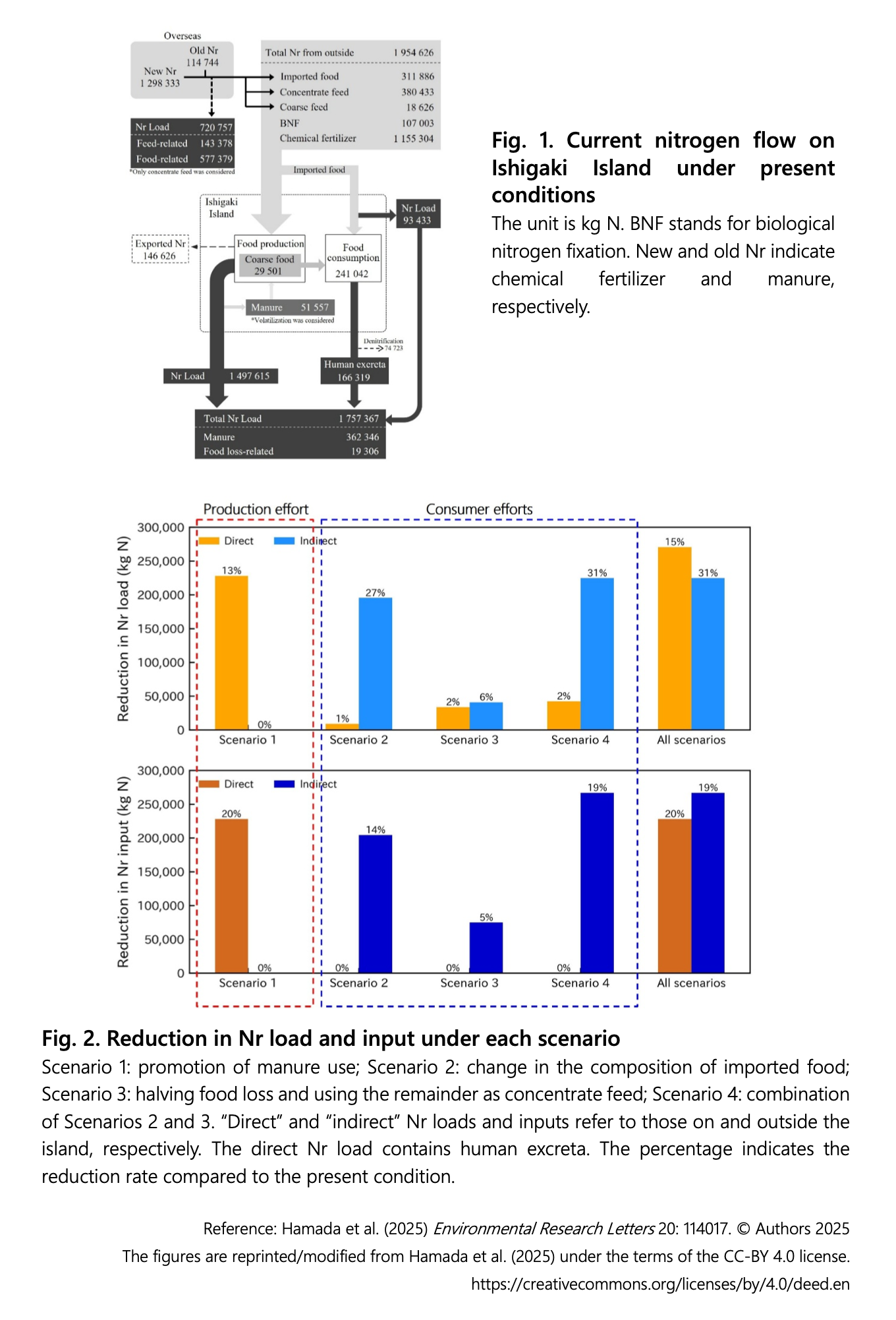
We calculated the food nitrogen footprint using official statistical data from Ishigaki City for 2022. For data unavailable at the city scale, we applied statistical data on food/feed production from the prefectural and national scales and data from previous studies. The amount of imported food Nr was estimated by compensating for the deficit in the food on the island using the food demand for Japan in 2015. The food loss ratio was 11%. We summed the Nr flows for all food items to assess the current Nr situation within the island’s food system and to estimate direct and indirect Nr loads and inputs (Fig. 1). To evaluate how production- and consumer-level efforts can mitigate Nr loads and inputs, the following scenarios were developed: (a) shifting diets toward grains and legumes in imported food, (b) halving food loss and using the remainder as concentrate feed, and (c) replacing chemical fertilizers with cattle manure produced on the island. Altering the composition of imported food, reducing food loss by half, and utilizing the remaining portion as feed effectively reduced the indirect Nr load, while using cattle manure reduced the direct Nr load. Implementing these measures in combination reduced the direct and indirect Nr loads by 15% and 31% and the direct and indirect Nr inputs by 20% and 19%, respectively (Fig. 2). Therefore, it is essential to implement consumer and production efforts simultaneously rather than independently to optimize the global nitrogen cycle.
This study allows us to evaluate the effect of production and consumers on the mitigation of Nr loads and inputs. This encourages the establishment of a policy that involves production and consumers and contributes to addressing the SDGs. However, these scenarios do not consider economics. Without showing the actual cost of replacing chemical fertilizers with manure and using food losses as eco-feed, adopting these measures would be difficult, even if they are environmentally beneficial. Exploring scenarios to further reduce Nr loads and inputs, such as applying other agricultural waste to farmland or livestock feed, is essential. These possibilities should be considered in future studies.
Figure, table
- Research project
- Program name
- Term of research
-
FY2021-2025
- Responsible researcher
-
Hamada Kosuke ( Tropical Agriculture Research Front )
ORCID ID0000-0003-4282-8677Eguchi Sadao ( National Agriculture and Food Research Organization (NARO) )
Hirano Nanae ( National Agriculture and Food Research Organization (NARO) )
Asada Kei ( National Agriculture and Food Research Organization (NARO) )
- ほか
- Publication, etc.
-
Hamada et al. (2025) Environmental Research Letters 20: 114017https://doi.org/10.1088/1748-9326/ae0b95
- Japanese PDF
-
2025_A04_ja.pdf1.02 MB
- English PDF
-
2025_A04_en.pdf379.66 KB
* Affiliation at the time of implementation of the study.