



Cowpea genetic resources tolerant to both drought and excess soil moisture and their root morphological adaptations
Related Research Project
Africa upland farming system
Country
Africa
Description
In the dry savannas of West Africa, smallholder farming systems depend heavily on rainfall and are therefore highly vulnerable to climate variability and climate change. In recent years, rainfall patterns have become increasingly erratic, causing not only drought but also temporary waterlogging following extreme rainfall events. Such fluctuations in soil moisture pose serious risks to crop production. In legumes such as cowpea, excess soil moisture leads to oxygen deficiency in the root zone, which suppresses plant growth and reduces yield. Developing crop varieties that can tolerate both drought and excess soil moisture has therefore become an urgent priority.
In collaboration with the International Institute of Tropical Agriculture (IITA), we evaluated 99 cowpea genetic resources, including 45 ancestral wild accessions collected from diverse environments and 54 cultivated accessions, mainly from the cowpea core collection. Stress tolerance was comprehensively assessed under both drought and excess soil moisture conditions using multiple physiological and growth indicators. Under drought conditions, SPAD values and chlorophyll fluorescence were used to evaluate leaf physiological status, while under excess soil moisture conditions, SPAD values and aboveground growth were used to assess plant performance.
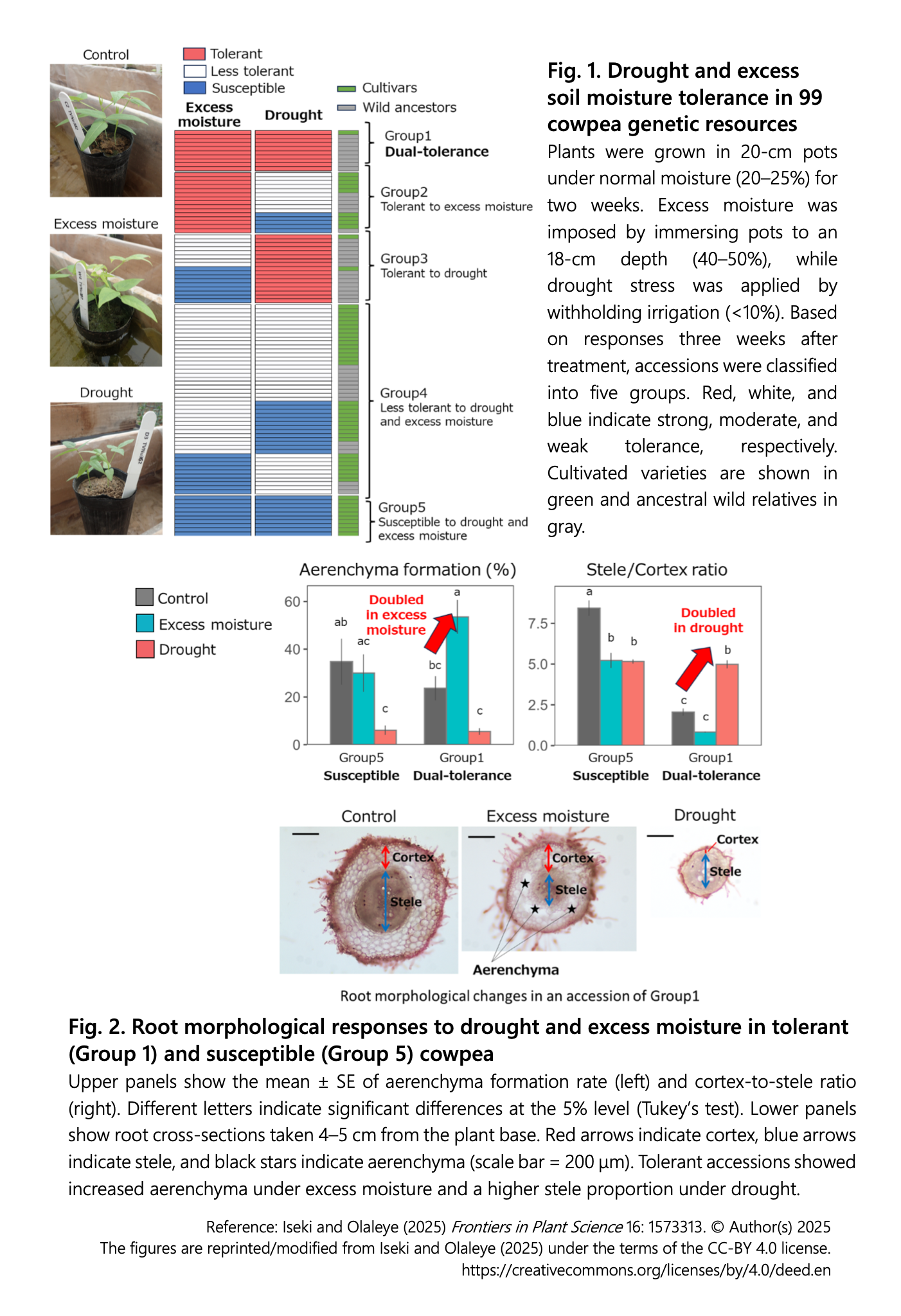
As a result, ten accessions showing tolerance to both drought and excess soil moisture were identified (Fig. 1). Notably, nine of these accessions were ancestral wild relatives, indicating that wild genetic resources retain valuable stress tolerance traits that are rarely found in cultivated varieties. Anatomical analyses revealed distinct root morphological responses associated with tolerance. Under excess soil moisture conditions, tolerant accessions increased the formation of root aerenchyma, facilitating internal oxygen transport and alleviating oxygen deficiency in the root zone (Fig. 2). In contrast, under drought conditions, they increased the proportion of vascular tissues in the stele, enhancing water transport efficiency from roots to shoots.
These results demonstrate that multi-indicator evaluation can effectively identify genetic resources tolerant to contrasting stresses such as drought and excess soil moisture. The tolerant genetic resources and their associated root traits identified in this study provide promising targets for breeding cowpea varieties adapted to future climates characterized by increasingly variable rainfall conditions.
Figure, table
- Research project
- Program name
- KAKEN
- Term of research
-
FY2017-2025
- Responsible researcher
-
Iseki Kohtaro ( Biological Resources and Post-harvest Division )
Olaleye Olajumoke ( International Institute of Tropical Agriculture )
- ほか
- Publication, etc.
-
Iseki and Olaleye(2025) Frontiers in Plant Science 16: 1573313https://doi.org/10.3389/fpls.2025.1573313
- Japanese PDF
-
2025_B10_ja.pdf1.87 MB
- English PDF
-
2025_B10_en.pdf975.78 KB
* Affiliation at the time of implementation of the study.