



Farmers’ views on soil fertility: Validity of farmers’ perceptions of soil fertility and their application to field management
Related Research Project
Africa upland farming system
Country
Ghana
Description
Soil fertility varies widely across the savanna zone of Sub-Saharan Africa, where smallholder farmers often face financial constraints in purchasing chemical fertilizers. In addition, since conventional soil testing methods remain costly, farmers adopt them only on a limited scale. Under such conditions, efficient allocation of limited resources—e.g., selecting appropriate crops and applying scarce organic amendments—is critical to sustain agricultural productivity. In contrast, farmers have long relied on experiential knowledge to assess soil fertility using observable indicators such as soil color and texture in a way that integrate these perceptions into everyday field management decisions. Understanding the validity and relevance of farmers’ soil assessments is therefore essential for promoting sustainable, locally adapted soil fertility management strategies.
This study examines croplands in Northern Ghana in the West African savanna and evaluates the consistency between farmers’ perceptions of soil fertility and the measured physicochemical properties of soils. Across 60 rural communities, soil samples were collected from 300 fields, and farmers managing these fields were interviewed regarding their field-level fertility assessments and management practices.
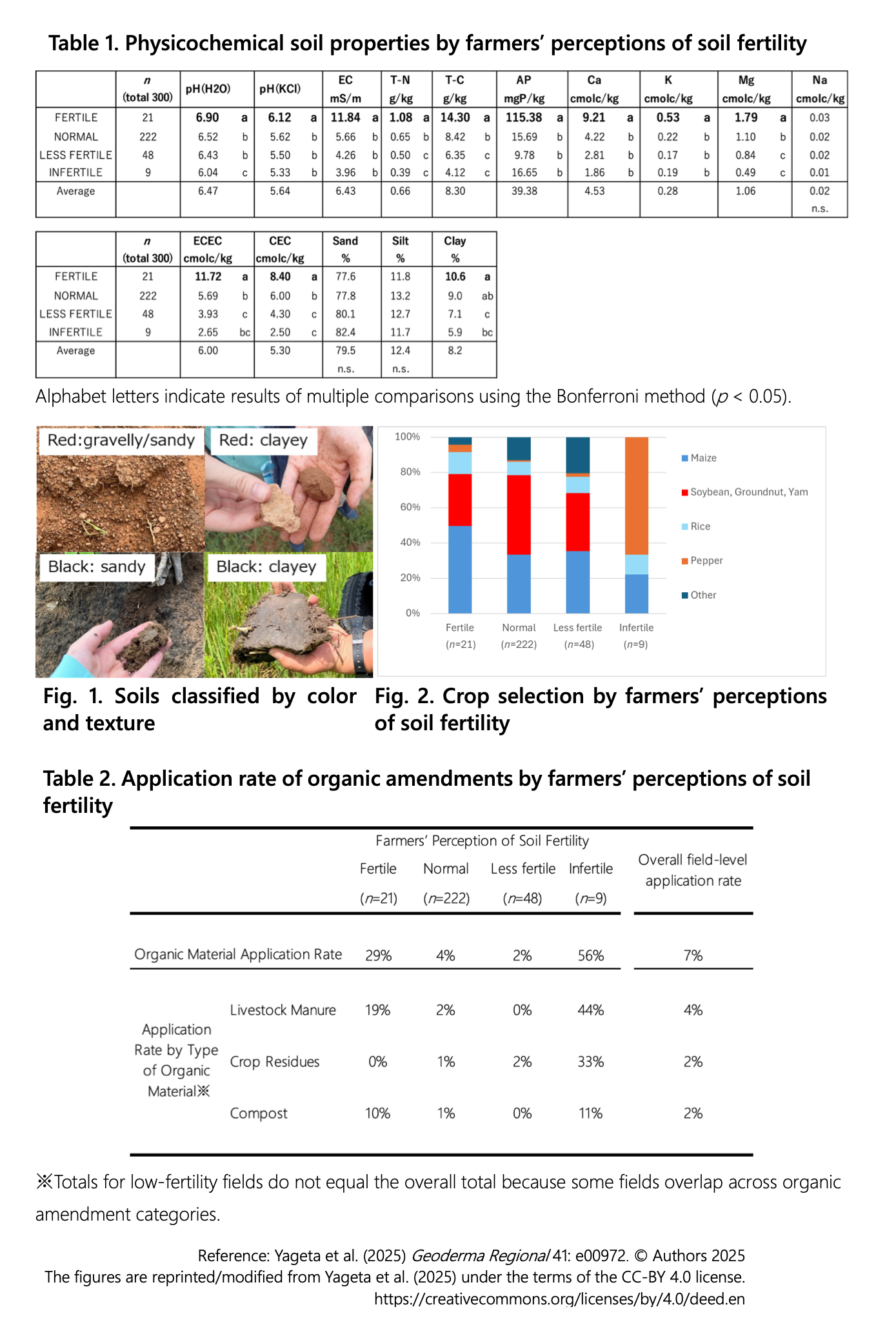
The farmers use soil color, soil texture, and weed species as the main indicators of soil fertility (Fig. 1). They categorize fields into fertile, normal, less fertile, and infertile classes. Perceived higher fertility is significantly associated with higher pH, EC, total C and N, available P, exchangeable bases, and cation exchange capacity—demonstrating strong alignment between farmer perceptions and empirical soil data (Table 1).
Farmers’ fertility assessments also shape crop choices (Fig. 2). As the main staple, maize is cultivated across all fertility levels, but cash crops such as groundnut, soybean, and yam are largely excluded from fields perceived as low fertility. Although the overall use of organic inputs remains low (7%), their application shows a distinct pattern (Table 2): farmers preferentially apply organic materials to fields considered either highly or very poorly fertile. This pattern suggests strategic allocation of scarce resources that balance the need for rehabilitating degraded soils with maximizing returns from productive fields.
The results highlight the value of integrating farmers’ soil knowledge into agricultural extension and policy planning. Utilizing farmer-based soil assessments can support the development of more context-appropriate recommendations for crop placement, fertilizer strategies, and sustainable soil management. Likewise, the broader adoption of organic amendments requires innovations that address current resource shortages as well as institutional support that improves access to organic inputs.
Figure, table
- Research project
- Program name
- Term of research
-
FY2021-2025
- Responsible researcher
-
Yageta Yoshie ( Social Sciences Division )
Koide Junji ( Social Sciences Division )
ORCID ID0000-0003-1726-4400Muranaka Satoru ( Information and Public Relations Office )
Nakamura Satoshi ( Crop, Livestock and Environment Division )
ORCID ID0000-0002-0952-5618KAKEN Researcher No.: 00749921 - ほか
- et al.
- Publication, etc.
-
Yageta et al. (2025) Geoderma Regional 41: e00972https://doi.org/10.1016/j.geodrs.2025.e00972
- Japanese PDF
-
2025_B12_ja.pdf3.73 MB
- English PDF
-
2025_B12_en.pdf1003.31 KB
* Affiliation at the time of implementation of the study.