



Rearing cost analysis of natural enemy insects for fall armyworm control in Thailand
Related Research Project
Transboundary pest management
Country
Thailand
Description
In Thailand, efforts to control the fall armyworm (Spodoptera frugiperda) have raised concerns about insecticide resistance, prompting the establishment of an integrated pest, disease, and weed management (IPM) system. As part of this initiative, the Department of Agriculture has promoted biological control through mass-rearing and distribution of multiple natural enemy species. However, the use of natural enemies remains limited, and their higher costs compared to chemical pesticides are major obstacles. Systematic knowledge of rearing costs is still insufficient, and variation in rearing scales reported in previous studies has hindered generalization. This study develops a cost estimation model that explicitly links release area to rearing scale, enabling evaluation of economic feasibility.
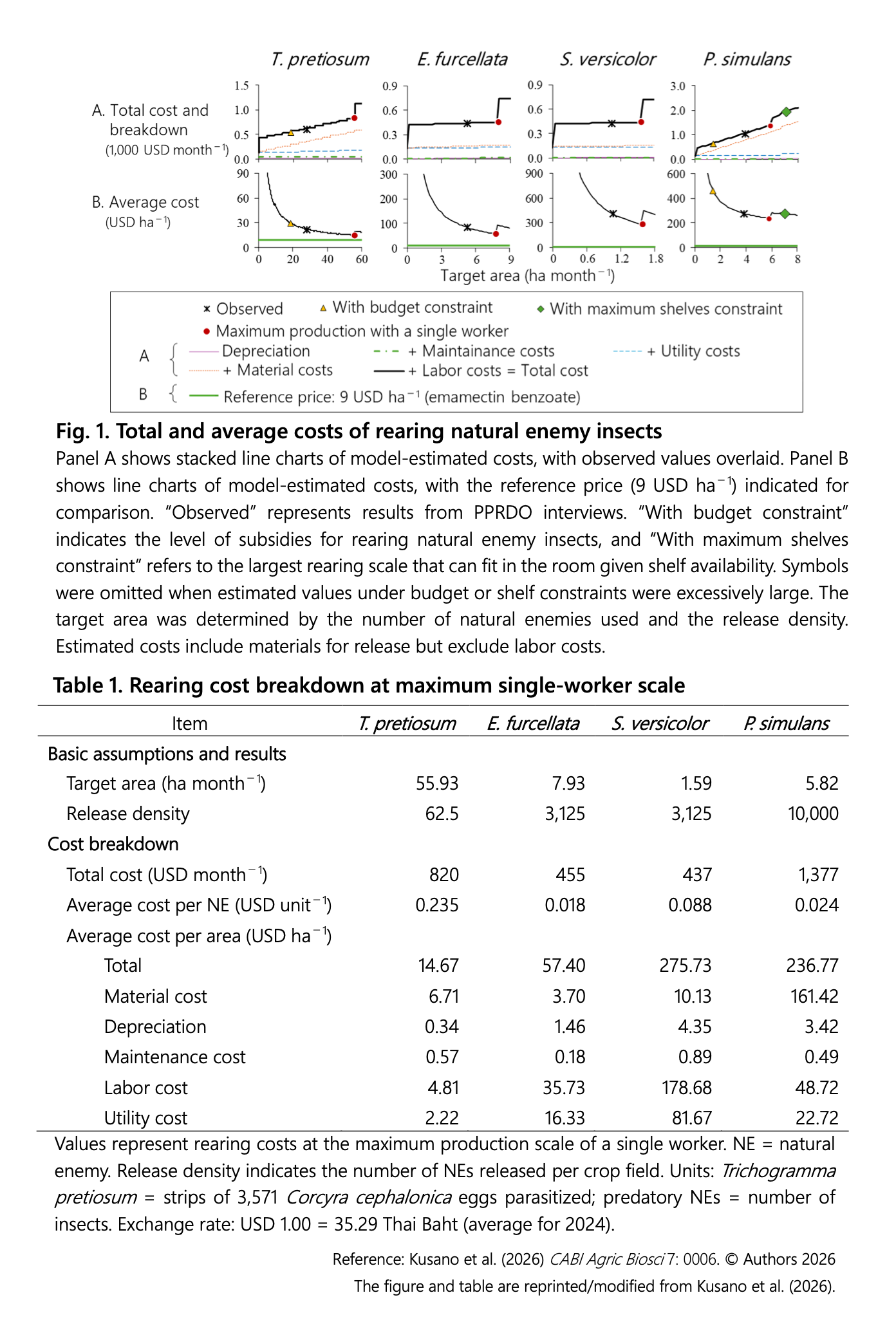
Rearing techniques at the Plant Protection Research and Development Office (PPRDO) of the Department of Agriculture were reviewed. Based on information for each operational step, required material quantities and costs were estimated from the maize area targeted for pest control. The natural enemies examined were the egg parasitoid wasp Trichogramma pretiosum and three predatory insects: Eocanthecona furcellata (stinkbug), Sycanus versicolor (assassin bug), and Proreus simulans (brown earwig). Assuming small-scale rearing at the maximum production capacity of a single worker, costs were estimated for each species. Results showed that average rearing cost per hectare declines with increasing release area due to the dilution of fixed costs (Fig. 1). For T. pretiosum, E. furcellata, and S. versicolor, water, utilities, and labor account for a large share of total costs, resulting in pronounced scale-related reductions (Fig. 1, Table 1). At maximum production scale, the rearing cost of T. pretiosum does not substantially exceed that of emamectin benzoate 5% water-dispersible granules, which are widely used in Thailand (≈9 USD ha−1), suggesting it could partially substitute for chemical control (Fig. 1B, Table 1).
The cost estimation approach is applicable to other species and regions, providing a basis for the economic assessment of biological control. The model is simplified for laboratory-level estimation, based on standardized production periods, single-worker capacity, and assumed release densities, and may require adjustment for specific objectives. The labor and costs associated with release operations, as well as the use and production of natural enemies during pest-free periods, also warrant examination. As this analysis relies solely on PPRDO data, further data collection and validation are needed. Beyond rearing costs, further research on control efficacy, optimal release densities, and integration with other control methods is needed to support practical implementation.
Figure, table
- Research project
- Program name
- Term of research
-
FY2021-2025
- Responsible researcher
-
Kusano Eiichi ( Social Sciences Division )
Kobori Youichi ( Crop, Livestock and Environment Division )
- ほか
- Publication, etc.
-
Kusano et al. (2026) CABI Agric Biosci. 7: 0006https://doi.org/10.1079/ab.2026.0006
- Japanese PDF
-
2025_B04_ja.pdf523.61 KB
- English PDF
-
2025_B04_en.pdf198.46 KB
* Affiliation at the time of implementation of the study.