



Identification of a quantitative locus, qPA1, derived from a black rice variety in Laos, which increases phytic acid content in grains
Related Research Project
Indigenous crops and foods design
Country
Laos
Description
Upland rice is mainly cultivated in the mountainous regions of northern Laos, where soil fertility is low and average yields remain around 2.0 t ha⁻¹. Black rice has traditionally been grown in this region and is an important crop supporting local diets due to its nutritional value and health benefits. However, poor growth under low-fertility conditions remains a major constraint to stable production. Approximately 60–90% of the phosphorus in grains exists as phytic acid (PA), which is sometimes considered to inhibit mineral absorption from a human nutritional perspective. In rice, however, PA serves as the primary phosphorus source during germination and early growth. Particularly under low-phosphorus conditions, PA functions as an important stored form of phosphorus that supports early seedling development. Therefore, PA is a key trait determining crop adaptability, and breeding programs should focus on phosphorus storage traits in grains. The objectives of this study are to identify a quantitative trait locus (QTL) associated with PA content in grains using a genetic population derived from a cross between Kampeng (a black rice variety from Laos) and Non (a stable, high-yielding white rice variety), and to propose a breeding strategy for developing black rice varieties with improved early growth and stable production under low-fertility conditions.
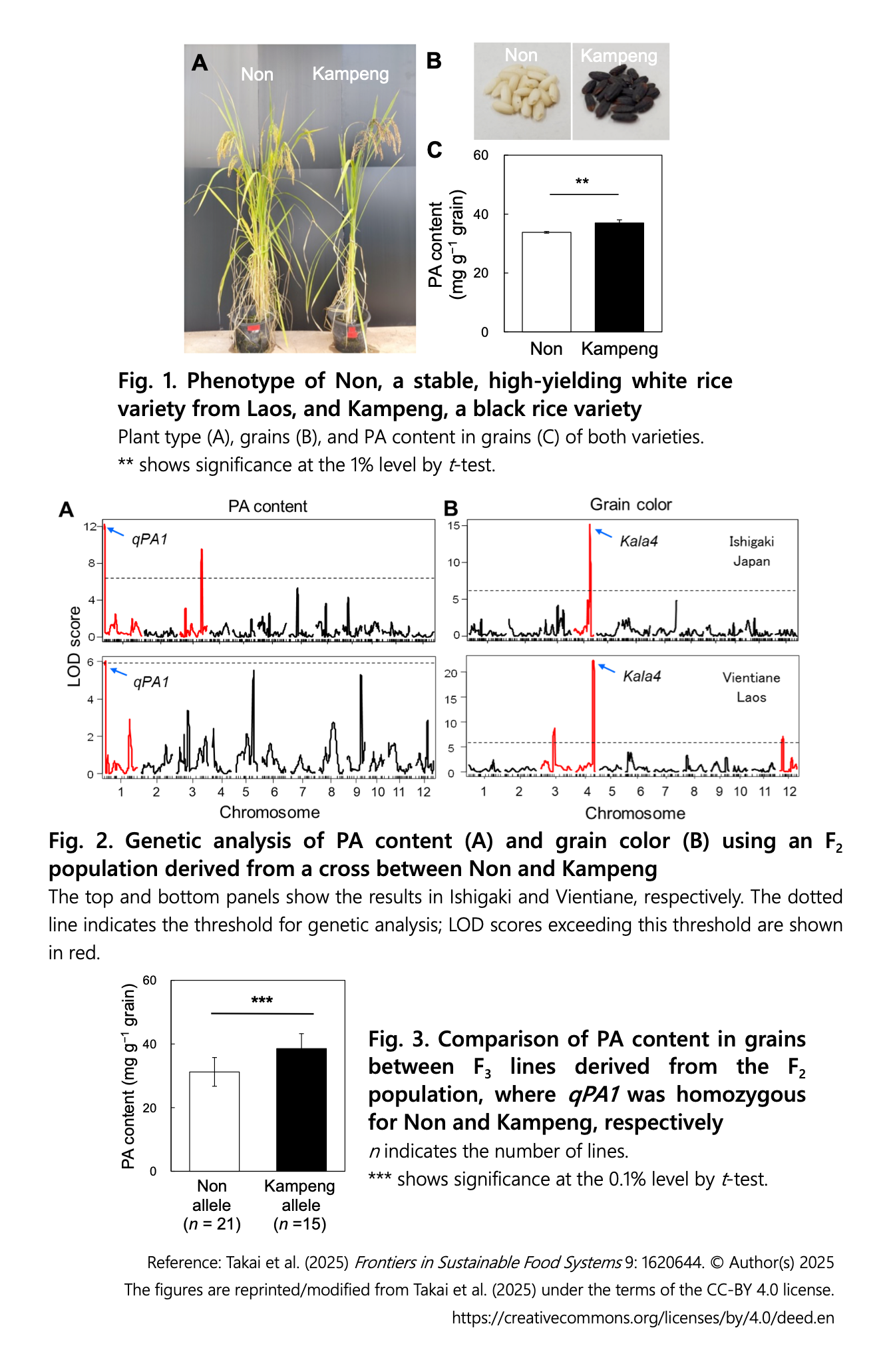
Results indicate that white rice variety Non produces more panicles and thus higher yield potential compared to black rice variety Kampeng (Fig. 1A, B). On the other hand, Kampeng shows higher PA content in grains compared to Non (Fig. 1C). Genetic analysis using an F2 population derived from a cross between Non and Kampeng identifies a novel QTL, qPA1, at the distal end of the short arm of chromosome 1 in both Ishigaki and Vientiane environments, which increases PA content with the Kampeng allele (Fig. 2A). A QTL associated with grain color was detected in Kala4, previously reported as a gene controlling the pigmentation of anthocyanins—a health-promoting component—and the Kampeng allele causes grain color to turn black (Fig. 2B). Subsequent studies using F3 lines derived from the F2 population confirm that the Kampeng allele enhances PA content by approximately 23% compared to the Non allele (Fig. 3).
Through backcross breeding, the introduction of the Kampeng alleles of qPA1 and Kala4 into Non makes it possible to develop a new black rice variety that exhibits high phosphorus supply capacity during germination and early growth, even under low-fertility conditions, while maintaining stable high yield.
Figure, table
- Research project
- Program name
- Term of research
-
FY2021-2024
- Responsible researcher
-
Takai Toshiyuki ( Crop, Livestock and Environment Division )
Asai Hidetoshi ( Crop, Livestock and Environment Division )
ORCID ID0000-0003-0125-1234KAKEN Researcher No.: 30599064Aung Zaw Oo ( Crop, Livestock and Environment Division )
Marui Junichiro ( Biological Resources and Post-harvest Division )
Saito Hiroki ( Tropical Agriculture Research Front )
Vilayheuang Koukham ( National Agriculture and Forestry Research Institute of Laos )
Phongchanmixay Sengthong ( National Agriculture and Forestry Research Institute of Laos )
- ほか
- Publication, etc.
-
Takai et al. (2025) Frontiers in Sustainable Food Systems 9: 1620644https://doi.org/10.3389/fsufs.2025.1620644
- Japanese PDF
-
2025_B02_ja.pdf1.1 MB
- English PDF
-
2025_B02_en.pdf303.99 KB
* Affiliation at the time of implementation of the study.