



Three Na⁺ exclusion transporters implicated in salt tolerance in quinoa
Country
Bolivia
Description
Salinity severely limits crop production worldwide, whereas major crops remain salt-sensitive. Quinoa (Chenopodium quinoa Willd.) is an exceptional crop that combines high nutritional value with remarkable tolerance to harsh environments, including high salinity. Although it is cultivated in extreme environments such as those surrounding the Salar de Uyuni, the mechanisms underlying its salt tolerance remain unclear.
Here, we investigated three genetically distinct quinoa subpopulations, namely the northern highland, southern highland, and lowland, using integrated physiological, transcriptomic, and genomic approaches to elucidate the mechanisms underlying its high salt tolerance.
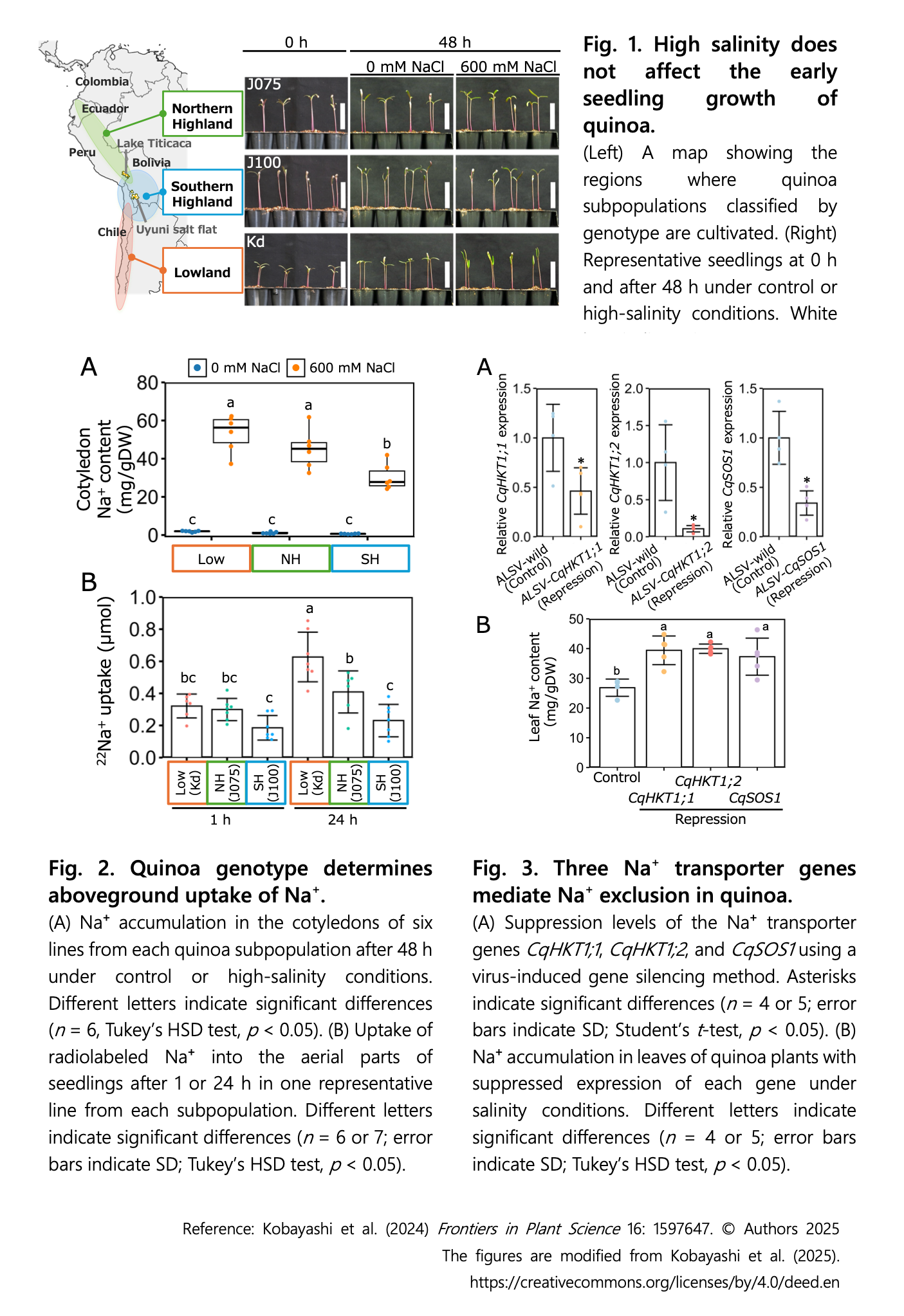
All 18 quinoa inbred lines representing the northern highland, southern highland, and lowland subpopulations maintained early seedling growth even under high salinity (600 mM NaCl), demonstrating high salt tolerance (Fig. 1). Under these conditions, K+ accumulation was markedly reduced in the roots but largely maintained in the aerial parts, indicating that quinoa preserves K+ levels in tissues essential for growth under high salinity. In contrast, Na+ accumulation in the cotyledons of salt-treated quinoa seedlings tended to be highest in the lowland lines, followed by the northern highland lines, and lowest in the southern highland lines around the Salar de Uyuni (Fig. 2A). Radiolabeled Na⁺ uptake experiments further revealed that this variation is attributable to differences in Na+ uptake into the aerial parts among genotypes (Fig. 2B). Expression of three Na+ transporter genes, CqHKT1;1, CqHKT1;2, and CqSOS1, did not change markedly in response to high salinity but differed substantially among subpopulations. Sequence polymorphisms in their regulatory regions suggest that genotype-dependent expression may contribute to variation in Na+ accumulation and salt tolerance. Functional analysis using virus-induced gene silencing showed that suppression of any of these genes increased Na+ accumulation in the aerial parts, indicating that these transporters play key roles in restricting Na+ entry into the shoot (Fig. 3A and B).
These findings provide new insight into the Na+ exclusion mechanism in quinoa and contribute to a better understanding of its remarkable salt tolerance. Elucidating this mechanism offers a valuable foundation for the development of salt-tolerant crops under increasing salinity stress worldwide. In addition, our results highlight the importance of considering genotype-specific variations in transporter gene sequences, which may influence gene expression patterns and transport activity, when investigating Na+ exclusion mechanisms in quinoa.
Figure, table
- Research project
- Program name
- KAKEN
- Term of research
-
FY2021-2025
- Responsible researcher
-
Kobayashi Yasufumi ( Biological Resources and Post-harvest Division )
ORCID ID0000-0002-8357-6579KAKEN Researcher No.: 00836968Murata Yoshinori ( Biological Resources and Post-harvest Division )
Ogata Takuya ( Biological Resources and Post-harvest Division )
ORCID ID0000-0003-3361-6234KAKEN Researcher No.: 00724501Nagatoshi Yukari ( Biological Resources and Post-harvest Division )
fujita Yasunari ( Program Director (Food) )
ORCID ID0000-0002-5036-8319KAKEN Researcher No.: 00446395Sugita Ryohei ( Nagoya University )
ORCID ID0009-0000-0858-1821KAKEN Researcher No.: 60724747Fujita Miki ( RIKEN )
ORCID ID0000-0003-4201-4876KAKEN Researcher No.: 70332294Yasui Yasuo ( Kyoto University )
ORCID ID0000-0003-3804-7886KAKEN Researcher No.: 70293917 - ほか
- Publication, etc.
-
Kobayashi et al. (2025) Front. Plant Sci. 16: 1597647https://doi.org/10.3389/fpls.2025.1597647
- Japanese PDF
-
2025_B01_ja.pdf3.29 MB
- English PDF
-
2025_B01_en.pdf1.28 MB
* Affiliation at the time of implementation of the study.