



A microbial saccharification method for efficient production of high-concentration sugar solutions from rice straw
Related Research Project
Carbon recycling
Country
Japan
Description
Rice straw is generated in large quantities across Asia, and open-field burning remains a common disposal method that contributes to air pollution, public health concerns, and transboundary haze problems. Converting rice straw into fermentable sugars provides an environmentally sound alternative and enables the production of biofuels and bio‑based chemicals. However, practical application requires high‑solids saccharification to obtain concentrated sugar solutions that improve downstream fermentation and purification efficiency. Conventional saccharification methods rely heavily on externally supplied enzymes, creating cost and supply constraints. This study aimed to develop an enzyme‑independent microbial saccharification process capable of stably producing high‑concentration sugar solutions under high‑solids conditions by optimizing culture operation and incorporating surfactant‑based stabilization.
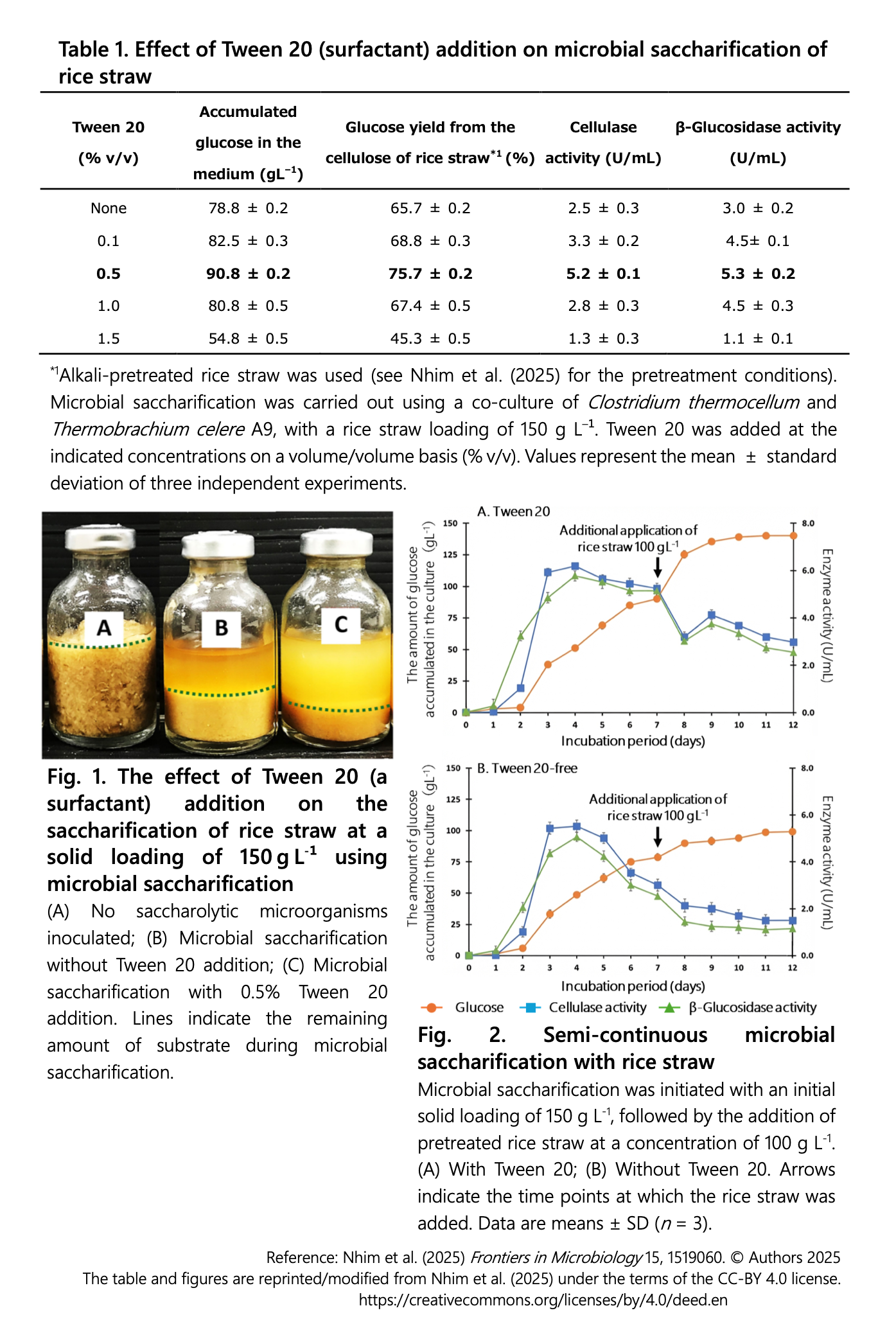
To address instability issues associated with high‑solids saccharification, such as poor mixing, non‑productive enzyme adsorption, and enzyme inactivation, we examined the effect of adding Tween 20 (a non‑ionic surfactant) to a co‑culture system comprising Clostridium thermocellum and the β‑glucosidase‑producing strain Thermobrachium celere A9. Tween 20 improved the retention of cellulase and β‑glucosidase activities, resulting in enhanced and more sustained saccharification performance. In parallel, a semi‑continuous operation strategy was developed in which pretreated rice straw was added stepwise during cultivation. Combining Tween 20 with this feeding strategy effectively prevented saccharification stagnation, even at high total solids. Under optimized conditions, a total substrate loading of 250 g L–¹ yielded 140 g L–¹ of glucose, corresponding to 70% of the theoretical yield, without the addition of external enzymes. These results demonstrate that both biochemical stabilization and operational design are essential for maintaining saccharification activity at high solids.
This microbial saccharification approach provides a cost‑effective and enzyme‑independent method for producing concentrated sugar solutions from underutilized biomass such as rice straw. It supports the development of sustainable biomass‑to‑chemicals pathways in Asia, where large volumes of agricultural residues are generated and environmentally sound disposal options are urgently needed. The semi‑continuous feeding concept offers practical insights for scaling up high‑solids saccharification, including considerations for substrate handling, mixing, and process control. Further evaluation of alternative low‑cost non‑ionic surfactants and their impacts on downstream processes will aid in refining industrial applicability. Overall, the system provides a promising foundation for expanding biomass utilization while reducing environmental burdens associated with current disposal practices.
Figure, table
- Research project
- Program name
- Term of research
-
FY2021-2025
- Responsible researcher
-
Nhima Sreyneang ( King Mongkut's University of Technology Thonburi )
Waeonukul Rattiya ( King Mongkut's University of Technology Thonburi )
Uke Ayaka ( Biological Resources and Post-harvest Division )
ORCID ID0000-0001-5077-8353Kosugi Akihiko ( Biological Resources and Post-harvest Division )
- ほか
- Publication, etc.
-
JIRCAS Press Release, June 2022: Development of Cellulose Saccharification Technology Using Microorganism Culture OnlyNhim et al. (2025) Frontiers in Microbiology 15:1519060https://doi.org/10.3389/fmicb.2024.1519060
- Japanese PDF
-
2025_A01_ja.pdf1.54 MB
- English PDF
-
2025_A01_en.pdf986.96 KB
* Affiliation at the time of implementation of the study.