



研究成果
Soil Conservation Technologies Passed Down from Farmer to Farmer: Clarifying the Actual Dissemination in West Africa
—Conditions and Potential of “Farmer-to-Farmer Extension” to Make Up for the Shortage of Extension Workers—
press202519.pdf917.95 KB
November 6, 2025
Japan International Research Center for Agricultural Sciences (JIRCAS)
Burkina Faso's Institute of the Environment and Agricultural Research (INERA)
|
Main Points
|
Overview
JIRCAS, in collaboration with Burkina Faso’s INERA, investigated how soil conservation technologies are disseminated in rural West Africa. The study clarified the reality of farmer-to-farmer extension1, where technologies are transferred "from farmer to farmer," as a new approach to supplement the conventional agricultural extension system.
In Burkina Faso and other sub-Saharan African countries, land degradation and climate change severely impact agricultural production. However, due to a chronic shortage of extension workers, effective technologies are not widely adopted, making farmers’ self-initiated efforts indispensable.
The study surveyed 650 sorghum farmers in central Burkina Faso to quantitatively analyze the adoption of traditional soil conservation methods such as using Zaï pits2 (holes dug to capture and retain rainwater) and stone lines3 (rows of stones arranged to reduce soil erosion), and applying organic fertilizer. The study used statistical methods to quantify adoption levels (Zero-truncated Tobit model4) and analyze binary choice behavior, such as whether to adopt or not (Logit model5).
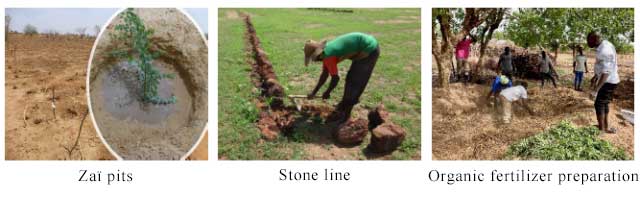
The results revealed that adoption and dissemination of technologies are not uniform; they vary significantly depending on farmers’ attributes and the social background of the village, confirming the following trends:
- Zaï pits: More likely to be adopted by farmers with larger plots or in villages with many local-born farmers. Educated farmers tend to pass the knowledge to neighbors.
- Stone lines: Adopted more in larger villages or by male-headed households; dissemination is more active in villages with strong religious ties.
- Organic fertilizers: Adoption is higher in villages with many local-born farmers, but no clear pattern of dissemination was observed.
- Farmers’ risk aversion6 does not significantly affect adoption or dissemination.
These findings indicate that farmer-to-farmer extension is not simply information transfer but is deeply rooted in social networks and community characteristics, depending on “who informs whom” and “what conditions are necessary for the technology.” The study suggests the need to incorporate often-overlooked factors into policy, such as designing dissemination strategies based on local trust and similarity networks, and providing support for women farmers in labor-intensive technologies.
This research provides practical guidance for achieving sustainable technology dissemination with limited resources, particularly in developing regions facing a shortage of agricultural extension workers.
The results of this research have been published as an open-access article in the online edition of the international scientific journal Land Degradation & Development (August 15, 2025, JST).
Related Information
- Funding
- Operating Expenses Grant Project: “Development of soil and crop management technologies to stabilize upland farming systems of African smallholder farmers (Africa upland farming system)”
Publication
- Authors
- Guenwoo Lee, Evéline M. F. W. Sawadogo-Compaoré (INERA, Burkina Faso), IKAZAKI Kenta, MURAOKA Rie
- Paper Title
- The Adoption and Dissemination of Soil Conservation Technologies among Sorghum Farmers in Burkina Faso: Perspectives on Innovation, Network, and Risk Aversion
- Journal Title
- Land Degradation & Development
DOI: https://doi.org/10.1002/ldr.70136
For Inquiries
JIRCAS President: KOYAMA Osamu
- Program Director:
- FUJITA Yasunari
- Research Staff:
- Lee Guenwoo (Social Sciences Division)
IKAZAKI Kenta (Crop, Livestock and Environment Division)
MURAOKA Rie (Social Sciences Division) - Press Coordinator:
- OMORI Keisuke (Head, Information and Public Relations Office)
Press Email: koho-jircas@ml.affrc.go.jp
Terminology
- 1 Farmer-to-Farmer Extension
A system in which farmers directly share their experience and knowledge with other farmers. Specifically, government extension workers provide technical training to a select group of farmers, who then pass on what they have learned to neighboring farmers. This system is particularly useful in areas with a shortage of government agricultural extension workers as allows techniques to be spread in a way that suits local conditions while keeping costs low.
- 2 Zaï pits
A traditional soil conservation technique that has long been used in the arid regions of West Africa. It involves digging holes about 30 cm in diameter and 20 cm deep, and placing seeds or seedlings in them along with compost. Originally, this technique was used to plant trees on degraded sloping land, but it later came to be used in fields as well. The small holes allow for the efficient collection and storage of rainwater, which helps prevent soil erosion while enhancing soil fertility through the addition of compost.
- 3 Stone Lines
A technique that involves lining up stones along the contours of a field to create gentle banks. This promotes the infiltration of rainwater, preventing soil erosion and increasing soil moisture, even in dry areas, thereby supporting crop growth. Over time, fertile soil gradually accumulates behind the stone lines, gradually improving soil fertility.
- 4 Zero-truncated Tobit model
A statistical method for analyzing quantitative data that cannot fall below zero, such as the area of technology adoption. It can analyze not only whether a technology has been adopted, but also the extent to which it has spread.
- 5 Logit model
A statistical model that probabilistically explains binary choice behavior, such as whether or not to adopt a specific technology. It can evaluate the impact of farmer attributes and environmental factors on adoption decisions.
- 6 Risk aversion
- A behavioral tendency reflecting a strong desire to avoid failure or loss.