



Soil organic carbon content in paddy soils of the central highlands of Madagascar is regulated by soil geochemistry
Country
Madagascar
Description
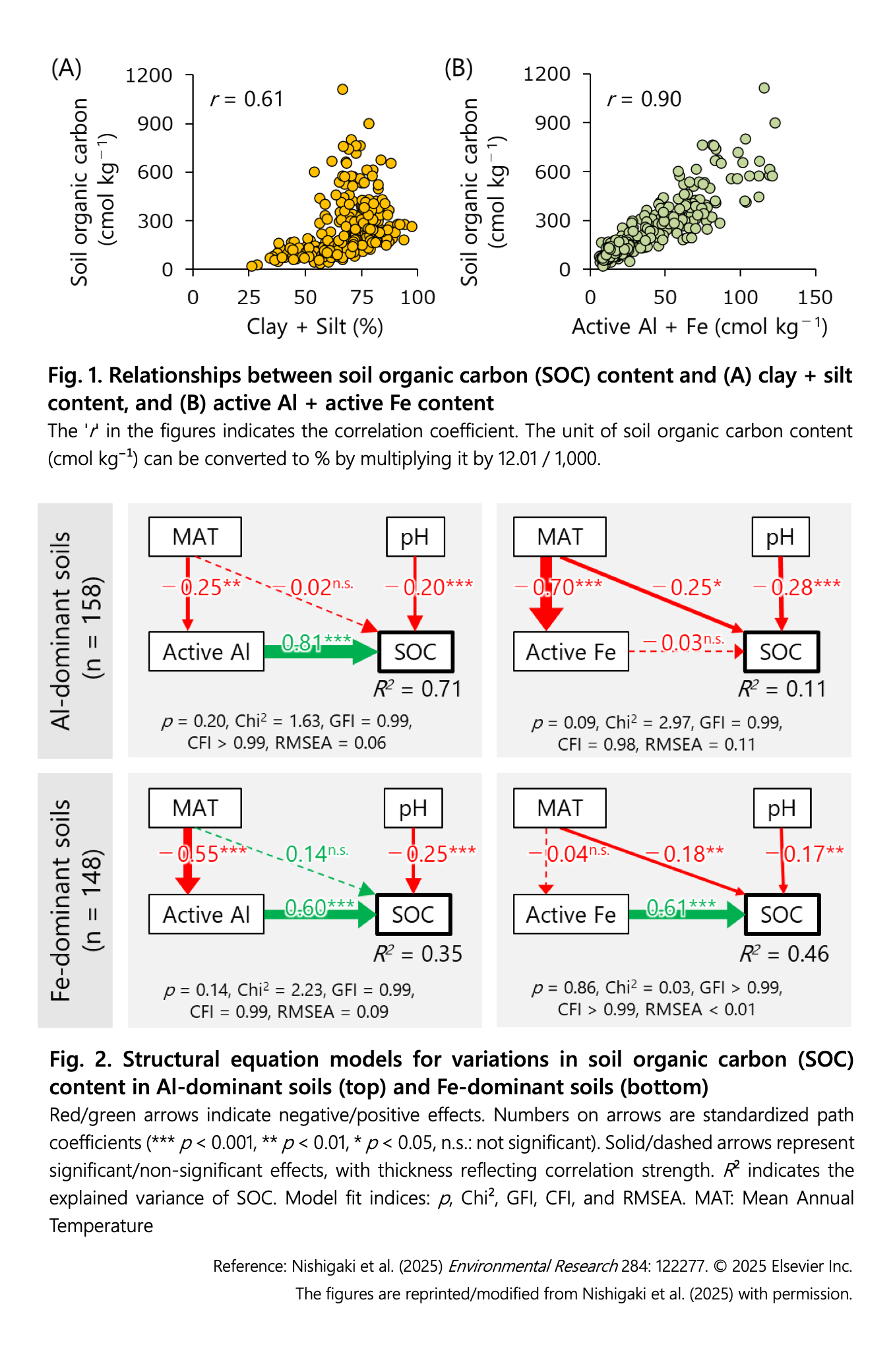
Understanding the mechanisms of soil organic carbon (SOC) stabilization is crucial for climate change mitigation. While acid-oxalate-extractable aluminum (active Al) and iron (active Fe) drive SOC stabilization in tropical upland soils, their roles in paddy soils remain poorly understood due to the complex redox dynamics from seasonal flooding and drainage. Furthermore, empirical data on SOC stabilization in sub-Saharan African paddy soils are notably scarce. To address this, this study utilized structural equation modeling to analyze 306 paddy fields across the central highlands of Madagascar. Encompassing diverse parent materials, from volcanic to non-volcanic soils, this first-of-its-kind large-scale comparative research aimed to elucidate the geochemical factors regulating SOC stability in tropical paddy soils.
The analysis revealed that SOC content (0.3% to 13.4%) correlated much more strongly with total active Al and Fe contents than with total clay and silt contents (Fig. 1). Structural equation modeling demonstrated that in Al-dominant soils (primarily volcanic), only active Al contributed to SOC stabilization, whereas in Fe-dominant soils (primarily non-volcanic), both active Al and active Fe played significant roles (Fig. 2). This finding provides the first empirical evidence that the relative balance of active Al and Fe primarily determines SOC stabilization in tropical paddy soils. Additionally, a consistent negative correlation was found between SOC content and soil pH across all soil types, indicating that elevated pH decreases SOC storage in these environments.
These findings highlight the importance of geochemical factors—such as volcanic influence, soil pH, and the ratios of active Al and Fe—in improving the prediction accuracy of carbon sequestration potential in similar tropical paddy ecosystems. Crucially, because raising soil pH through artificial amendments may inadvertently reduce SOC, these results emphasize the need to integrate organic matter inputs when neutralizing acidic tropical soils to balance pH correction with effective SOC storage. While these insights apply to regions sharing similar conditions with the central highlands of Madagascar, further verification is essential before applying them to paddy environments with extended flooding periods, such as triple-cropping systems or floodplains where soil properties are frequently altered by sediment deposition.
Figure, table
- Research project
- Program name
- Term of research
-
FY2017-2022
- Responsible researcher
-
Nishigaki Tomohiro ( Crop, Livestock and Environment Division )
ORCID ID0000-0002-6669-803XKAKEN Researcher No.: 80795013Tsujimoto Yasuhiro ( Crop, Livestock and Environment Division )
ORCID ID0000-0001-7738-9913KAKEN Researcher No.: 20588511Okamoto Takanori ( Crop, Livestock and Environment Division )
ORCID ID0000-0003-4506-473XAung Zaw Oo ( Crop, Livestock and Environment Division )
Lyu Han ( Tokyo University of Agriculture and Technology )
ORCID ID0000-0001-7778-3654KAKEN Researcher No.: 20945349Rakotonindrina Hobimiarantsoa ( University of Antananarivo )
ORCID ID0000-0001-5857-9471Andriamananjara Andry ( University of Antananarivo )
ORCID ID0000-0001-5372-7359Razafimbelo Tantely ( University of Antananarivo )
ORCID ID0000-0003-2101-9715Rakotoarisoa Njato Mickaël ( Centre National de Recherche appliquée au Développement Rural, Madagascar )
ORCID ID0000-0001-5857-9471 - ほか
- Publication, etc.
-
Nishigaki et al. (2025) Environmental Research 284: 122277https://doi.org/10.1016/j.envres.2025.122277
- Japanese PDF
-
2025_B16_ja.pdf1.41 MB
- English PDF
-
2025_B16_en.pdf283.06 KB
* Affiliation at the time of implementation of the study.