



Selective application of farmyard manure improves rice yields in phosphorus-deficit paddies in Sub-Saharan Africa
Country
Africa
Description
Rice demand in Sub-Saharan Africa is increasing rapidly, yet rice productivity remains low, averaging only 2.3 t ha⁻¹. Smallholder farmers in the region often cultivate rice under severe soil fertility constraints, particularly in strongly weathered soils where phosphorus (P) deficiency is common. Although mineral fertilizers can increase yields, their high cost and limited accessibility often restrict their use. Under such conditions, farmyard manure (FYM), which can be produced locally from livestock manure and plant residues, represents an important on-farm resource. Previous studies have suggested that organic amendments such as FYM can improve P availability by mobilizing soil-bound P, but evidence from farmers’ fields showing how FYM effectiveness varies with soil P status has remained limited.
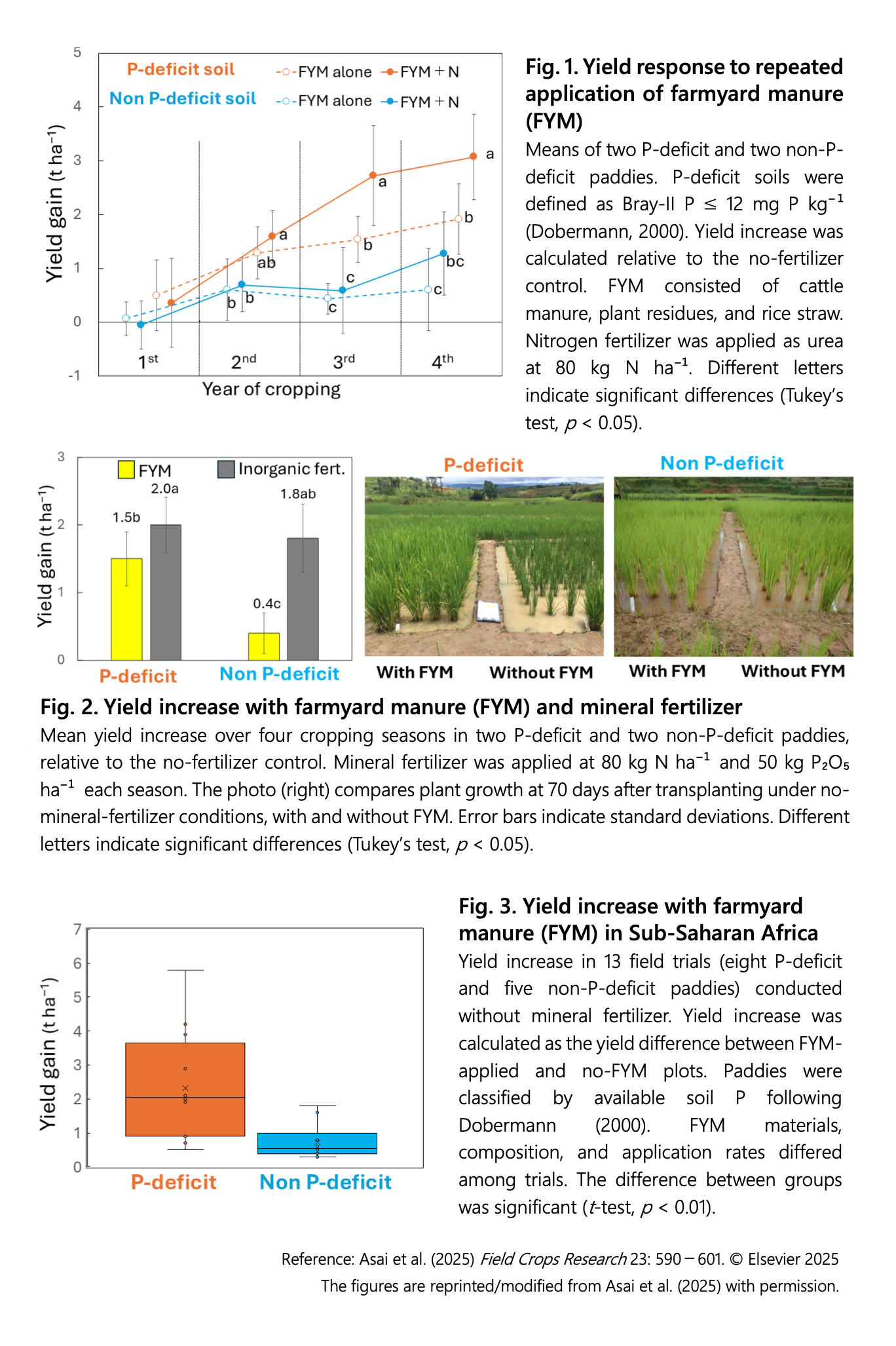
To address this gap, field experiments were conducted for four consecutive cropping seasons in four farmers’ rice paddies in the central highlands of Madagascar that differed in available soil P. FYM was applied annually at 10 t ha⁻¹ (fresh weight), corresponding to the level commonly used by local farmers. Yield responses to FYM were substantially greater in P-deficit paddies than in non-deficit paddies. Over four seasons, the average yield gain with FYM reached 1.5 t ha⁻¹ in P-deficit paddies, compared with only 0.4 t ha⁻¹ in non-deficit paddies (Fig. 1). The cumulative effect of repeated FYM application also became larger over time, and the greatest response was observed when FYM was combined with nitrogen (N) fertilizer, with yield gains of up to 3.1 t ha⁻¹. In P-deficit paddies, the average yield gain achieved with FYM alone corresponded to 77% of that obtained with inorganic N and P fertilizer (Fig. 2). In addition, a synthesis of 13 field trials from six countries in Sub-Saharan Africa showed the same general pattern, confirming that FYM application is consistently more effective under P-deficit conditions (Fig. 3).
These results demonstrate that the agronomic effectiveness of FYM depends strongly on soil P status and that P-deficit paddies should be prioritized when FYM resources are limited. The findings provide a scientific basis for the selective use of FYM in rice systems of Sub-Saharan Africa. By targeting FYM to fields where it is most effective, farmers can make more efficient use of locally available organic resources, improve rice productivity, and reduce reliance on costly mineral fertilizers.
Figure, table
- Research project
- Program name
- Term of research
-
FY2017-2024
- Responsible researcher
-
Asai Hidetoshi ( Crop, Livestock and Environment Division )
ORCID ID0000-0003-0125-1234KAKEN Researcher No.: 30599064Tsujimoto Yasuhiro ( Crop, Livestock and Environment Division )
ORCID ID0000-0001-7738-9913KAKEN Researcher No.: 20588511Nishigaki Tomohiro ( Crop, Livestock and Environment Division )
ORCID ID0000-0002-6669-803XKAKEN Researcher No.: 80795013Andriamananjara Andry ( University of Antananarivo )
ORCID ID0000-0001-5372-7359Rakotonindrina Hobimiarantsoa ( University of Antananarivo )
ORCID ID0000-0001-5857-9471 - ほか
- Publication, etc.
-
Asai et al. (2025) Field Crops Research 23: 590−601https://doi.org/10.1016/j.fcr.2025.109932
- Japanese PDF
-
2025_B14_ja.pdf2.28 MB
- English PDF
-
2025_B14_en.pdf881.47 KB
* Affiliation at the time of implementation of the study.