



Socio-structural factors in the adoption and farmer-to-farmer dissemination of soil conservation technologies
Related Research Project
Africa upland farming system
Country
Burkina Faso
Description
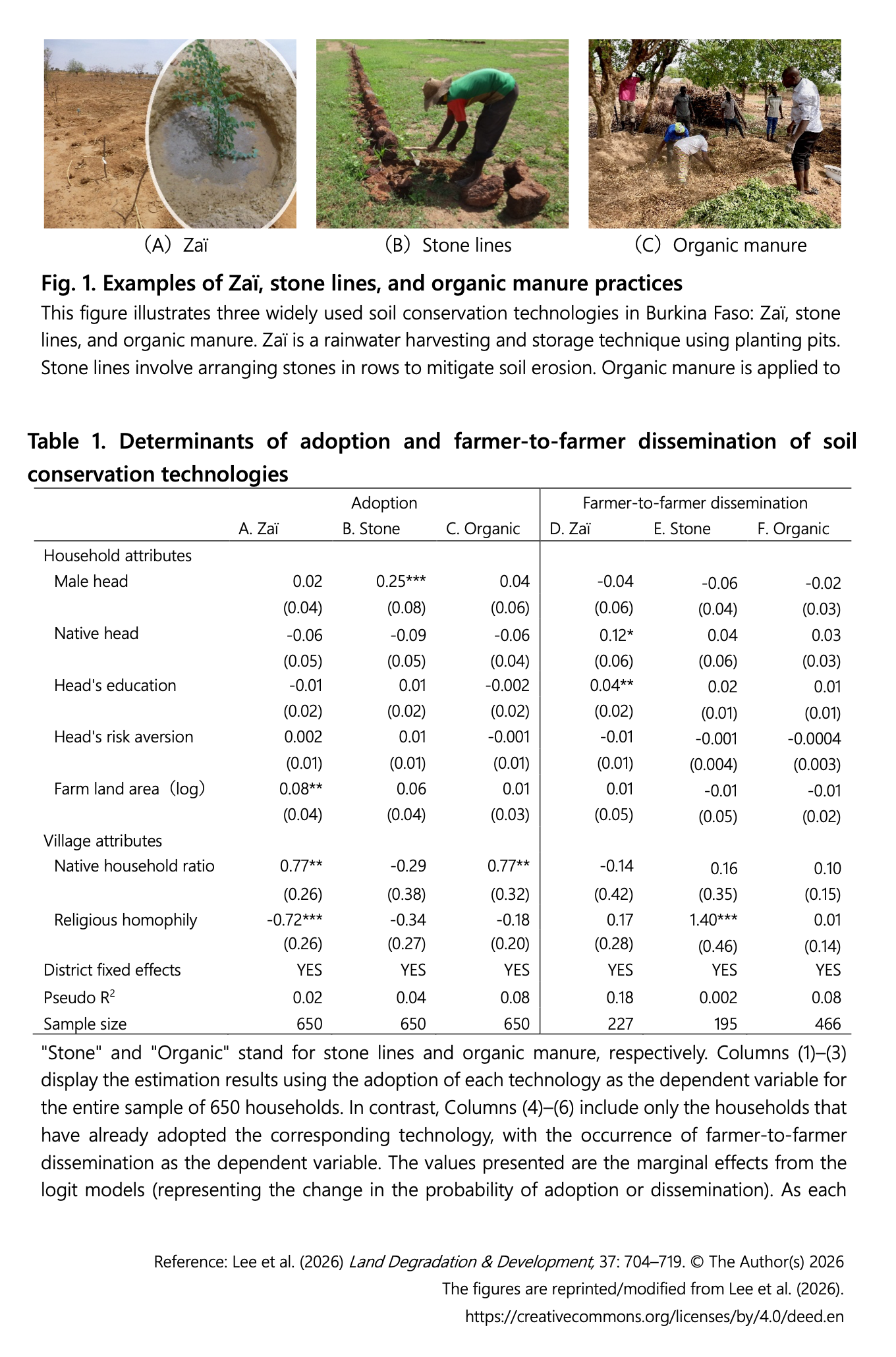
In Burkina Faso, erratic rainfall and overcultivation cause severe soil degradation. Although farmers use traditional conservation technologies like Zaï (Fig. 1A), stone lines (Fig. 1B), and organic manure (Fig. 1C), their widespread adoption remains limited. A primary barrier is the chronic shortage of public extension workers. While farmer-to-farmer extension—sharing technologies among peers—is a promising supplement, empirical knowledge regarding the conditions for its success and dissemination pathways remains insufficient. This study aims to comprehensively understand farmer-to-farmer extension and quantitatively assess how socio-structural factors and technology-specific traits impact dissemination.
The results reveal that Zaï adoption correlates positively with larger landholdings and higher proportions of native residents, whereas religious homophily acts as a constraining factor (Table 1A). Its dissemination is driven by native and highly educated farmers (Table 1D), highlighting the role of resources and local connections. In the case of labor-intensive stone lines are adopted mostly by male-headed households (Table 1B) and disseminate effectively in villages with strong religious homophily (Table 1E), suggesting that social cohesion supports the necessary collaborative labor. Finally. As for organic manure, adoption increases with the proportion of native residents (Table 1C), but its dissemination shows no statistically significant differences across social groups (Table 1F). Furthermore, risk aversion—measured via behavioral games—shows no correlation with technology adoption or dissemination (Table 1). This indicates that social constraints and role divisions, rather than individual risk preferences, primarily drive adoption.
These findings support the development of practical extension models that complement public systems in resource-constrained regions. By leveraging the identified social conditions, extension strategies can be customized based on local trust networks. Specifically, highly educated and native residents can serve as effective hubs for Zaï, whereas cohesive religious communities are ideal for spreading stone lines. Given the tendency for male-headed households to adopt labor-intensive practices, introducing support packages tailored to specific technology characteristics ensures that female farmers are not excluded. This approach helps establish sustainable dissemination models applicable beyond Burkina Faso. Finally, since environmental factors like precipitation were not fully examined, future research should integrate both social and natural conditions for comprehensive extension designs.
Figure, table
- Research project
- Program name
- Term of research
-
FY2022-2024
- Responsible researcher
-
Lee Guenwoo ( Social Sciences Division )
ORCID ID0000-0001-5623-6205KAKEN Researcher No.: 80836643Ikazaki Kenta ( Crop, Livestock and Environment Division )
ORCID ID0000-0001-5460-8570KAKEN Researcher No.: 70582021Muraoka Rie ( Social Sciences Division )
ORCID ID0000-0002-6944-2996KAKEN Researcher No.: 00760753Evéline M. F. W. Sawadogo-Compaoré ( Environmental Institute for Agricultural Research, Burkina Faso )
ORCID ID0000-0003-4661-1790 - ほか
- Publication, etc.
-
Lee et al. (2026) Land Degradation & Development 37(2), 704-19.https://doi.org/10.1002/ldr.70136
- Japanese PDF
-
2025_B13_ja.pdf758.48 KB
- English PDF
-
2025_B13_en.pdf402.15 KB
* Affiliation at the time of implementation of the study.