



Leaf nitrogen concentration indicates the growth rate of Falcataria falcata, a major fast-growing tree in Southeast Asia
Country
Indonesia
Description
Falcataria falcata, a leguminous tree native to Indonesia, the Solomon Islands, and Papua New Guinea, is among the fastest-growing tree species in the world. Owing to its moderate wood strength and good workability, its timber is in high demand for wood products such as laminated lumber and plywood. However, growth rates vary greatly among individuals even within the same plantation. To improve wood productivity, it is essential to select fast-growing individuals and achieve more uniform growth in plantations. Identifying simple traits associated with growth rate would help shorten the time required for selecting superior trees. Leaf traits such as photosynthetic rate and specific leaf area (SLA) often correlate with growth rate, potentially serving as useful indicators. For F. falcata, however, differences in growth rate and leaf traits among genetically different populations remain unclear. In this study, we examined the relationships between growth rate, photosynthetic rate, and leaf traits among genetically different populations originating from Indonesia and the Solomon Islands.
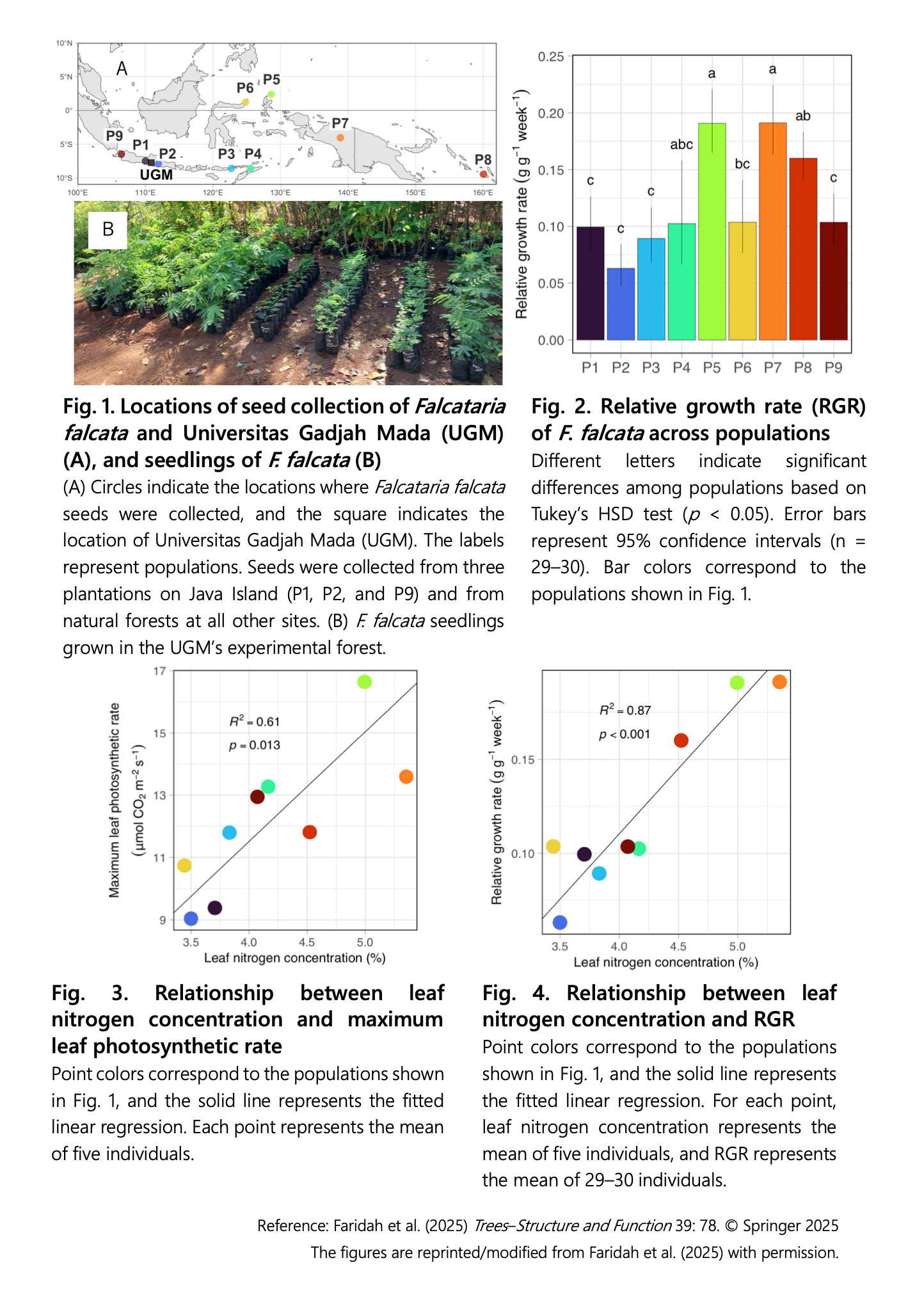
Seeds of F. falcata collected from nine locations in Indonesia and the Solomon Islands (Fig. 1A) were grown under common environmental conditions (Fig. 1B). Relative growth rate (RGR)* over three weeks (Fig. 2), maximum leaf photosynthetic rate**, and leaf nitrogen concentration varied greatly among populations, whereas no significant differences were observed in SLA. The population-mean of leaf nitrogen concentration was positively associated with that of maximum leaf photosynthetic rate (Fig. 3) and RGR (Fig. 4).
These results suggest that leaf nitrogen concentration can be used as an indicator of growth performance and can accelerate the selection of fast‑growing individuals. We also suggest that growth rate and photosynthetic traits in F. falcata have a genetic basis. These traits can therefore be utilized in breeding programs to develop varieties with superior growth performance and physiological characteristics. Conducting similar assessments in plantations and in mature trees will further strengthen the applicability of these findings.
*Relative growth rate (RGR): growth rate per unit biomass, where higher values indicate more efficient growth
**Maximum leaf photosynthetic rate: the maximum rate of leaf photosynthesis measured under non-limiting conditions of light, water, and temperature
Figure, table
- Research project
- Program name
- Term of research
-
FY2021-2025
- Responsible researcher
-
Kawai Kiyosada ( Forestry Division )
ORCID ID0000-0001-8224-0515KAKEN Researcher No.: 50846334Tanaka Kenzo ( Forestry Division )
ORCID ID0000-0002-4856-7204KAKEN Researcher No.: 30414486Tani Naoki ( Forestry Division )
ORCID ID0000-0001-9878-6352KAKEN Researcher No.: 90343798Faridah Eny ( Gadjah Mada University )
ORCID ID0000-0001-7795-5129Figyantika Arom ( Gadjah Mada University )
ORCID ID0000-0002-7783-7568Romadini Pratiwi Nesty ( Gadjah Mada University )
ORCID ID0009-0006-3016-7655Sawitri ( Gadjah Mada University )
ORCID ID0009-0000-2925-7027Prehaten Daryono ( Gadjah Mada University )
ORCID ID0000-0002-1070-1893Widiyatno ( Gadjah Mada University )
ORCID ID0000-0002-6611-5009Mohammad Na’iem ( Gadjah Mada University )
ORCID ID0000-0002-8239-6189Tsumura Yoshihiko ( University of Tsukuba )
ORCID ID0000-0002-9844-0914KAKEN Researcher No.: 20353774 - ほか
- Publication, etc.
-
Faridah et al. (2025) Trees 39: 78https://doi.org/10.1007/s00468-025-02652-8
- Japanese PDF
-
2025_A03_ja.pdf1.9 MB
- English PDF
-
2025_A03_en.pdf1.6 MB
* Affiliation at the time of implementation of the study.