



Intergeneric hybrid between sugarcane and Erianthus exhibits superior leaf water-use efficiency compared to sugarcane
Related Research Project
Tropical crop genetic resources
Country
Japan
Description
Erianthus arundinaceus, a closely related genus to sugarcane (Saccharum spp.), is expected to contribute to improving sugarcane’s drought tolerance through interspecific hybridization. So far, JIRCAS has reported Erianthus traits associated with drought tolerance, including excellent root system development, leaf gas exchange characteristics (water use efficiency; WUE—calculated by dividing photosynthetic rate by stomatal conductance, a measure of transpiration), and metabolite adaptations. While reports exist on the root system development of intergeneric hybrids between sugarcane and Erianthus, there are no reports on the leaf characteristics (gas exchange and morphological traits) of their hybrids, and the potential for improving sugarcane leaf characteristics through intergeneric hybridization remains unclear.
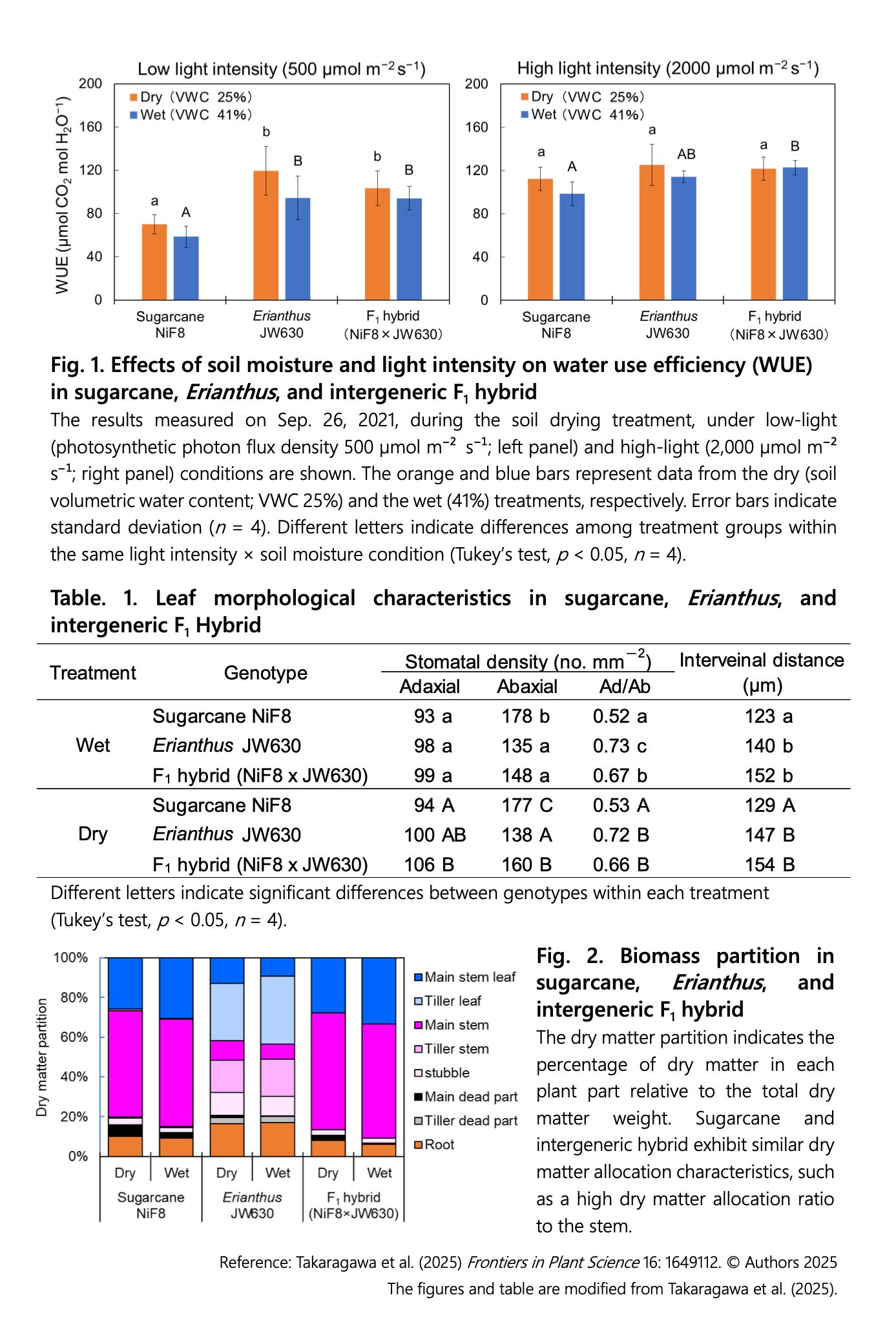
We investigated the leaf gas exchange characteristics, morphological traits, and dry matter allocation patterns of a sugarcane variety (NiF8), an Erianthus accession (JW630), and an intergeneric F1 hybrid (J16-77 [NiF8 x JW630]) derived from these parents under pot conditions at JIRCAS-TARF, to verify the potential for improving these traits through intergeneric hybridization. Although the difference was not significant under high-light conditions, Erianthus showed higher WUE than that of sugarcane regardless of soil moisture conditions (Fig. 1). Genotypic differences in WUE became more pronounced under low-light conditions (photosynthetic photon flux density of 500 µmol m⁻² s⁻¹) compared to high-light conditions (2,000 µmol m⁻² s⁻¹) during gas exchange measurements (Fig. 1). Compared to sugarcane, Erianthus has a lower stomatal density on the abaxial side of the leaves, a higher ratio of adaxial to abaxial stomatal density, and longer interveinal distances (Table 1). These differences are largely due to genetic factors. Sugarcane allocates a large proportion of dry matter to the stem, whereas Erianthus allocates more to the leaves and roots (Fig. 2). The WUE and stomatal density of the F1 hybrid are comparable or close to those of the Erianthus parent (Fig. 1, Table 1). On the other hand, the F1 hybrid shows a large proportion of dry matter allocation to the stem similar to that of the sugarcane parent (Fig. 2).
Through intergeneric hybridization, it is possible to develop hybrids that inherit leaf characteristics from the Erianthus parent and dry matter allocation to the stem from the sugarcane parent, thereby combining the characteristics of both parents. The F1 hybrid possesses desirable above-ground traits which may contribute to improving sugarcane drought tolerance, although further field studies will be required. Because the tested F1 hybrid has low sugar content at harvest, improving sugar content through backcrossing with sugarcane varieties is necessary for their utilization as breeding materials.
Figure, table
- Research project
- Program name
- Term of research
-
FY2021-2023
- Responsible researcher
-
Takaragawa Hiroo ( Tropical Agriculture Research Front )
ORCID ID0000-0002-6238-1078KAKEN Researcher No.: 70851260Teraiima Yoshifumi ( Tropical Agriculture Research Front )
Okamoto Ken ( Tropical Agriculture Research Front )
ORCID ID0000-0002-4893-0034 - ほか
- Publication, etc.
-
Takaragawa et al. (2025) Frontiers in Plant Science 16: 1649112https://doi.org/10.3389/fpls.2025.1649112
- Japanese PDF
-
2025_C02_ja.pdf456.59 KB
- English PDF
-
2025_C02_en.pdf319.34 KB
* Affiliation at the time of implementation of the study.