



Scalable Research Achievement
Technical guidelines for improving water use efficiency in irrigation areas in Africa
Related Research Project
Africa rice farming system
Country
Africa
Description
In Sub-Saharan Africa, rice consumption has consistently outpaced domestic production, leading to a critical reliance on imports. Therefore, it is essential to increase productivity within irrigation schemes. However, there are some cases where the actual irrigated area falls short of the planned command area due to the functional deterioration of water facilities and inefficient water management. These guidelines were developed to expand technical options by proposing new countermeasures that contribute to efficient water utilization.
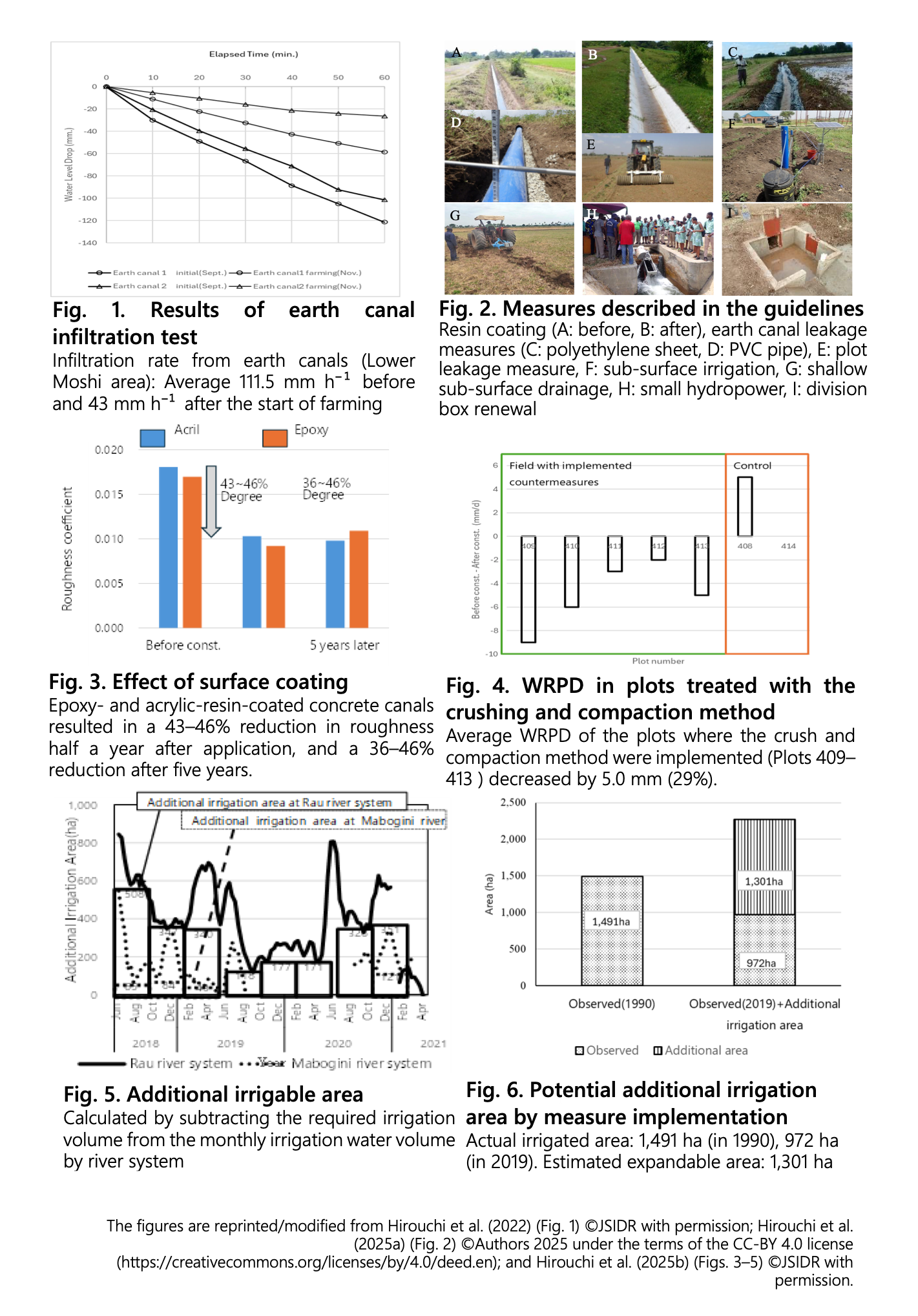
In the Lower Moshi area, leakage in earth canals was measured at 43 mm h–1 after the commencement of farming (Fig. 1). By implementing countermeasures to mitigate leakage (Fig. 2C, D), water loss is reduced, enabling the supply of additional water to downstream areas. Furthermore, concrete canal surfaces become increasingly rough over time, impairing water flow. A resin-based coating method (Fig. 2B) can significantly improve water flow by 36% to 46% (Fig. 3). In the same cross section as that used in the field trial, this resulted in a flow rate increase of 56% to 84% (at a water depth of 0.6 m). Implementing plot leakage countermeasures—such as towing a Cambridge roller (Fig. 2E) and removing the topsoil to directly compact the hardpan—resulted in a 5 mm reduction in water requirement per day (WRPD) (Fig. 4). These guidelines describe several other methods to increase the irrigated area through efficient water utilization, including: upgrading diversion works, improving field drainage using cut drains, powering pump irrigation with small-scale hydropower using the flow within irrigation canals, installing recirculation subsurface irrigation powered by solar energy (Fig. 2F–I), adopting water-saving cultivation via the alternate wetting and drying (AWD) method, and implementing appropriate water allocation to improve water use efficiency (Fig. 5).
By applying these technologies to the 2019 conditions of the Lower Moshi District, there is potential to expand the irrigated area to 2,273 ha (152% of the original planned command area of 1,500 ha) (Fig. 6). These guidelines are available in English, Japanese, and Swahili on the JIRCAS website.
Successful implementation requires addressing financial and social factors. Since many of these technologies involve initial costs, the development of agricultural credit systems is recommended. While these methods are designed for broad application by farmers and engineers, pilot testing is advised to adapt them to local soil and climatic conditions. Crucially, as these improvements benefit the entire irrigation block rather than just individual plots, fostering community consensus and collective agreement among water users is vital for the sustainable management of improved water resources.
Figure, table
- Research project
- Program name
- Term of research
-
FY2017-2024
- Responsible researcher
-
Hirouchi Shinji ( Rural Development Division )
ORCID ID0000-0002-0398-3677MIERUKA ID: 001783Onishi Junya ( Rural Development Division )
Yamada Masaichi ( Rural Development Division )
MIERUKA ID: 001786Shindo Soji ( Rural Development Division )
Furihata Hideki ( Rural Development Division )
MIERUKA ID: 001734Ishijima Mitsuo ( Rural Development Division )
Uno Kenichi ( Rural Development Division )
Yanagihara Seiji ( Vice-President )
Hirose Chikako ( ex-Rural Development Division )
MIERUKA ID: 001803Uchimura Motomu ( ex-Rural Development Division )
Yokoyama Shigeki ( ex-Social Sciences Division )
- ほか
- Publication, etc.
-
Hirouchi et al. (2022) Journal of the Japanese Society of Irrigation, Drainage and Rural Engineering 90(6)https://doi.org/10.11408/jjsidre.90.6_415Yokoyama (2022) Japanese Journal of Farm Management 59(4)https://doi.org/10.11300/fmsj.59.4_69
For the promotion of rice cultivation in Africa Recommended Technology Guideline
Hirouchi et al. (2025) Journal of the Japanese Society of Irrigation, Drainage and Rural Engineering 93(6) - Japanese PDF
-
2025_B17_ja.pdf1.28 MB
- English PDF
-
2025_B17_en.pdf818.68 KB
* Affiliation at the time of implementation of the study.