



Improved tolerance to iron toxicity in rice by knock-down of a citrate transporter FRDL1
Related Research Project
Africa rice farming system
Country
Africa
Description
Iron (Fe) toxicity is a nutrient disorder that specifically affects lowland rice, limiting its productivity in many regions such as Sub-Saharan Africa and Southeast Asia, typically resulting in yield losses of more than 10%. Despite its significance, our understanding of the genes and mechanisms to enhance Fe toxicity tolerance is limited, and breeding efforts have seen little success. Therefore, further investigation is needed to identify genes that can be used for tolerance breeding. In this study, the author focused on the fact that Fe within roots is transported to the shoot in the form of a citrate-Fe complex, and investigated the effects of mutating citrate transporters on Fe toxicity tolerance.
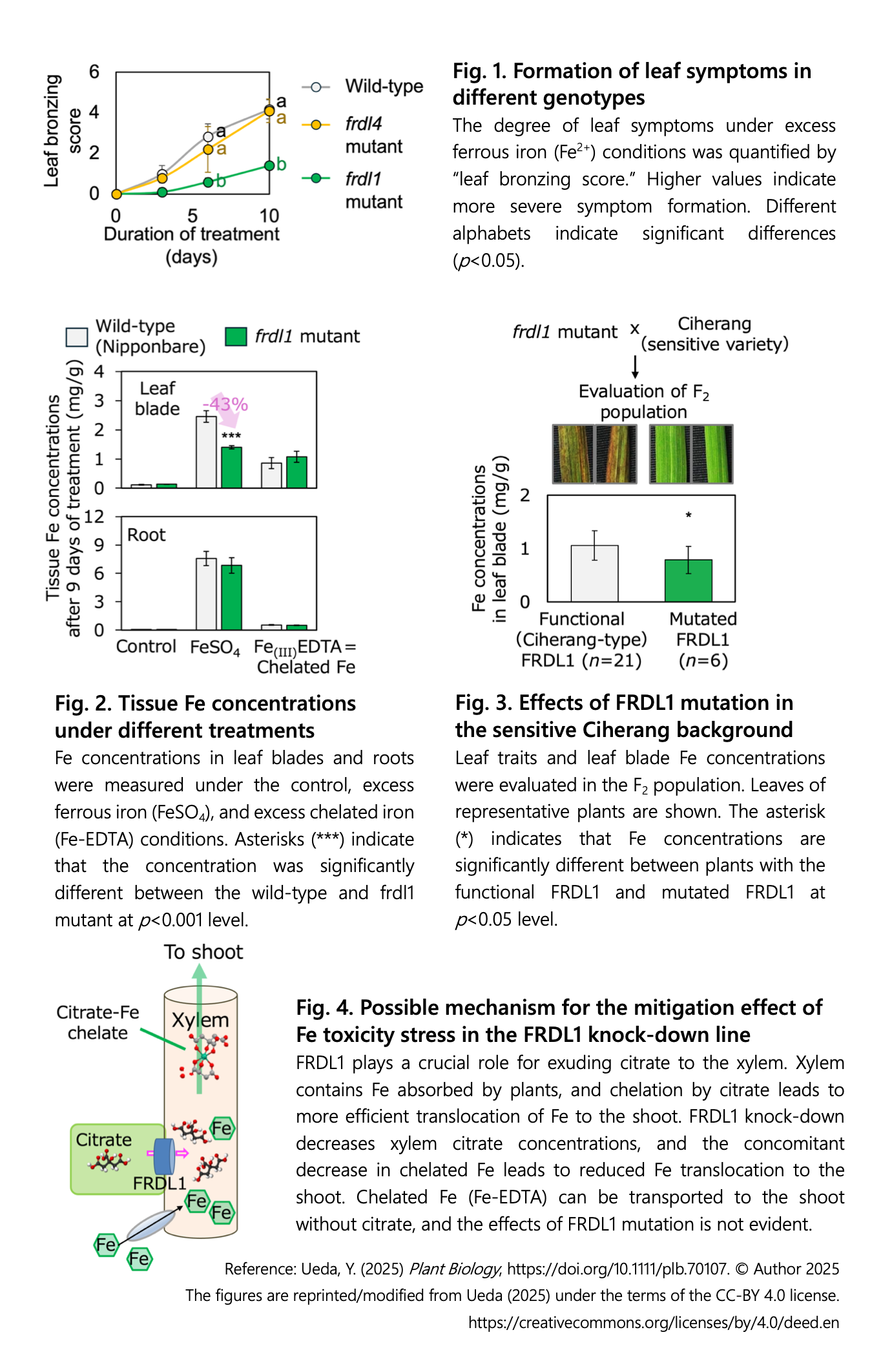
Wild-type plants, along with loss-of-function mutants for FRDL1 (a transporter that releases citrate in the xylem) and FRDL4 (a transporter that releases citrate to the rhizosphere) were evaluated in a hydroponic system with varying amounts and forms of Fe. Tolerance levels and the mechanisms were examined by measuring foliar symptoms and tissue Fe concentrations. The results showed that the frdl1 mutant, but not the frdl4 mutant, exhibited increased tolerance to Fe toxicity (Fig. 1). This suggests that xylem citrate plays a crucial role in determining Fe toxicity tolerance in rice plants, while citrate released in the rhizosphere is less important, at least in the hydroponic system. The frdl1 mutant exhibited significantly lower Fe concentrations in leaf blades under excess ferrous iron (Fe2+) conditions compared to wild-type plants, while root concentrations remained unaffected (Fig. 2). Contrary to the observation under excess Fe2+ conditions, reductions in leaf blade Fe concentrations were not observed under excess chelated Fe (Fe-EDTA) conditions. This suggests that the FRDL1 mutation alleviates Fe toxicity stress only when excess Fe is provided in the form of unchelated Fe2+. To assess if the frdl1 mutation could enhance tolerance in a sensitive variety, the frdl1 mutant (Nipponbare background) was crossed with a sensitive indica variety, Ciherang, and the resulting F2 population was evaluated under excess Fe2+ conditions. Individuals with the functional Ciherang-type FRDL1 exhibited severe symptoms with high leaf Fe concentrations, while those with the non-functional, mutated FRDL1 showed milder stress symptoms and significantly lower leaf Fe concentrations (Fig. 3).
These results suggest that a malfunctioning of FRDL1 leads to decreased xylem citrate concentrations, resulting in less efficient root-to-shoot Fe translocation (Fig. 4). This indicates that FRDL1 is a promising target to reduce leaf Fe concentration under Fe toxicity conditions. Further research is necessary to understand the factors that regulate the expression of FRDL1 in roots and apply this knowledge to practical breeding efforts.
Figure, table
- Research project
- Program name
- Term of research
-
FY2022-2025
- Responsible researcher
-
Ueda Yoshiaki ( Crop, Livestock and Environment Division )
ORCID ID0000-0002-4304-368XKAKEN Researcher No.: 70835181 - ほか
- Publication, etc.
-
Ueda (2025) Plant Biol.https://doi.org/10.1111/plb.70107
- Japanese PDF
-
2025_B15_ja.pdf879.95 KB
- English PDF
-
2025_B15_en.pdf441.52 KB
* Affiliation at the time of implementation of the study.