



Soil type–specific sorghum cultivation strategies for maximizing yield and net return in the Sudan Savanna
Related Research Project
Africa upland farming system
Country
Africa
Description
To meet the rapidly increasing food demand in Sub-Saharan Africa (SSA), improving agricultural productivity in the region is essential. In countries across the Sudan Savanna, the largest sorghum-producing region in SSA, agricultural recommendations are being revised. However, differences in soil types—which significantly influence sorghum yield—have not yet been taken into account.
Therefore, this study aims to identify optimal combinations of nitrogen (N) application rate, planting density, and variety (i.e., optimal cultivation practices) that maximize sorghum yield and net return from fertilization in three dominant soil types in the Sudan Savanna: Lixisols (LX), characterized by a deep effective soil depth (~100 cm); Plinthosols with medium effective depth (~50 cm; PT); and Plinthosols with shallow effective depth (~25 cm; PX).
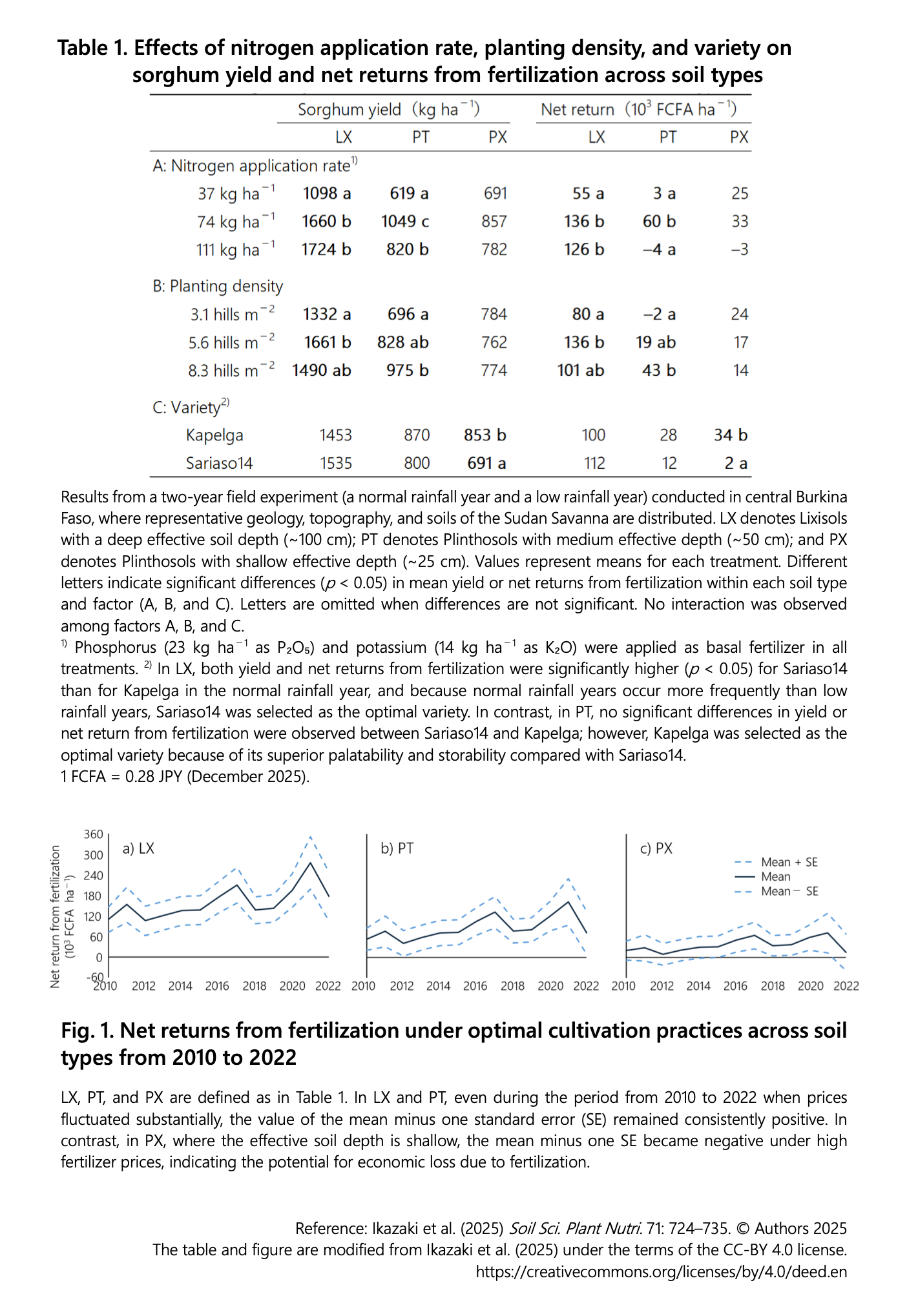
The optimal cultivation practices identified through two years of field experiments were as follows (Table 1):
LX: 74 kg N ha−1, 5.6 plants m−2, Sariaso14
PT: 74 kg N ha−1, 8.3 plants m−2, Kapelga
PX: 37 kg N ha−1, 3.1 plants m−2, Kapelga
As expected, these practices differed depending on soil type. Current agricultural recommendations for sorghum in each country generally prescribe an N application rate of around 30 kg ha−1 regardless of soil type. However, increasing the N application rate in LX and PT can improve both yield and net return. Based on fertilizer prices and farm-gate prices of sorghum in Burkina Faso from 2010 to 2022, a period during which prices fluctuated significantly, the net returns from fertilization under the optimal practices was calculated. The average net returns followed the order LX > PT > PX, reflecting differences in effective soil depth (Fig. 1). The economic robustness of the optimal cultivation practices also differed among soil types. In LX and PT, net returns from fertilization remained positive even under high fertilizer prices, whereas in PX, where the effective soil depth is shallow, net returns could become negative (Fig. 1).
These findings can be used to improve existing agricultural recommendations for sorghum in countries across the Sudan Savanna, making them more fertilizer-efficient. However, sorghum yields and net returns from fertilization in this study were obtained under fertilization practices recommended by INERA: a basal application immediately after sowing, followed by top-dressing at 4 and 6 weeks after sowing. Therefore, even with the same total N application rate, different application timings or frequencies may not yield the same results.
Figure, table
- Research project
- Program name
- Term of research
-
FY2016-2025
- Responsible researcher
-
Ikazaki Kenta ( Crop, Livestock and Environment Division )
ORCID ID0000-0001-5460-8570KAKEN Researcher No.: 70582021Iseki Kohtaro ( Biological Resources and Post-harvest Division )
Nagumo Fujio ( Japan International Cooperation Agency )
KAKEN Researcher No.: 20399372Simporé Saïdou ( Environmental Institute for Agricultural Research, Burkina Faso )
Barro Albert ( Environmental Institute for Agricultural Research, Burkina Faso )
- ほか
- Publication, etc.
-
Ikazaki et al. (2025) Soil Sci. Plant Nutri. 71(6): 724–735https://doi.org/10.1080/00380768.2025.2522832
- Japanese PDF
-
2025_B09_ja.pdf685.94 KB
- English PDF
-
2025_B09_en.pdf229.83 KB
* Affiliation at the time of implementation of the study.