



Seedling production technology for gametophytes of the red alga Asparagopsis taxiformis utilizing its life cycle
Related Research Project
Ecosystem approach to aquaculture
Country
Japan
Description
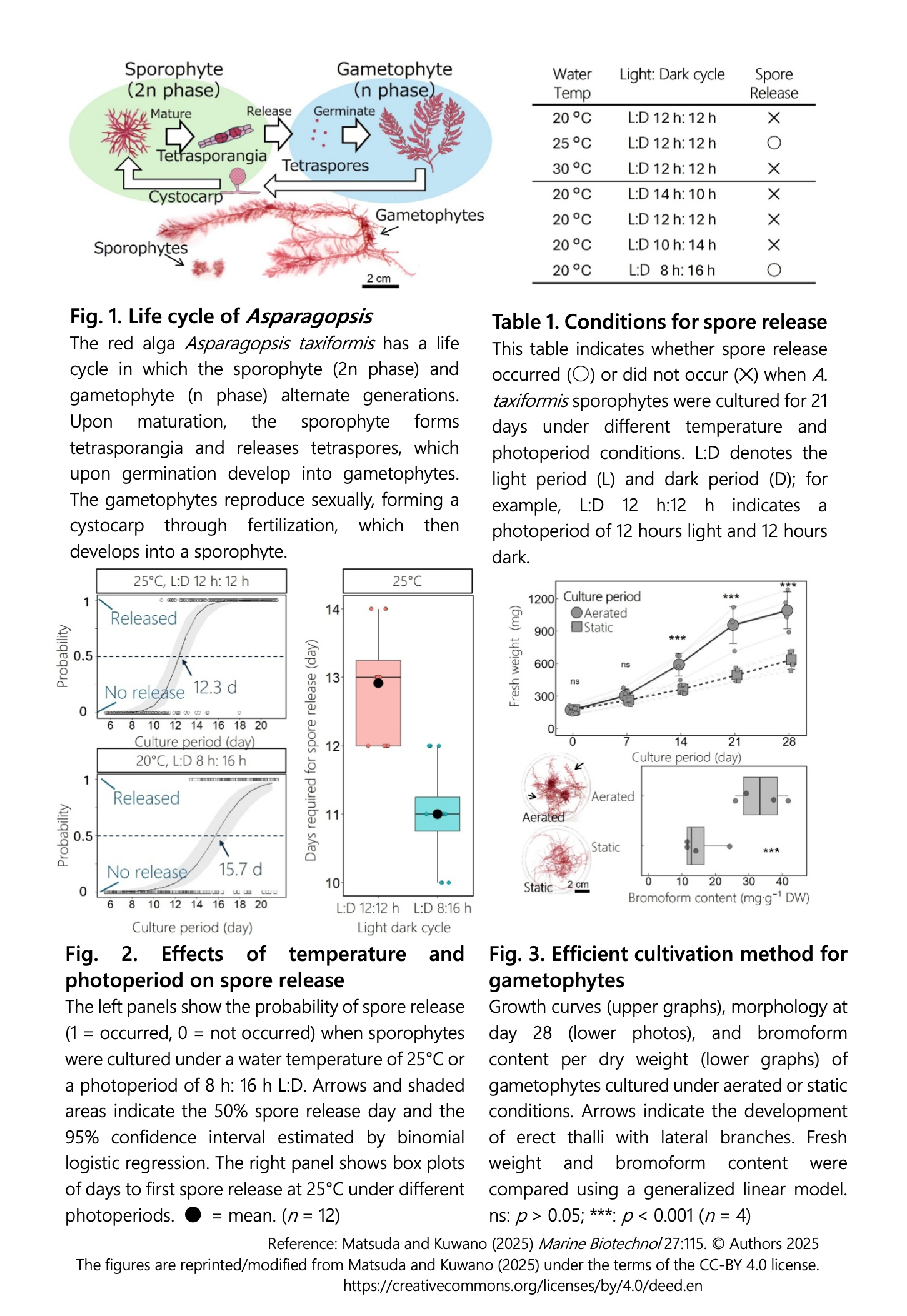
The red alga Asparagopsis taxiformis has recently attracted attention as a promising seaweed for reducing methane emissions from ruminant livestock due to its high content of bromoform, a compound known to inhibit microbial methanogenesis. However, the practical implementation of its aquaculture requires the establishment of a stable and efficient seedling supply system.
A. taxiformis has a heteromorphic life cycle that consists of sporophyte (2n) and gametophyte (n) phases. While sporophytes are too small to be cultured in marine environments, gametophytes are applicable to marine farming, which is less costly and suitable for large-scale cultivation. This study focuses on the alternation of generations in A. taxiformis, to develop techniques for seedling production suitable for sea-based cultivation by inducing spore release from sporophytes and promoting the growth of gametophytes.
The results demonstrate that sporophytes can be stably maintained at 20°C under a 12 h light: 12 h dark photoperiod, but maturation and tetraspore release are effectively induced under either elevated temperature (25°C) or short-day conditions (8 h light: 16 h dark). These two factors act independently, yet exhibit a synergistic effect when combined, reducing the time required for initial spore release to approximately 11 days. Under other conditions, neither maturation nor spore release was observed, indicating that precise environmental control is essential for reliable seed production.
Furthermore, the growth of gametophytes derived from spores is significantly enhanced under aerated culture conditions. Over a four-week period, the daily growth rate increased from 4.72% under static conditions to 6.86% with aeration. Aerated cultures also showed more pronounced development of upright axes, lateral branches, and basal structures. In addition, the bromoform content per unit dry weight was substantially higher under aeration, indicating improved functional quality.
These findings provide a practical foundation for low-cost, large-scale marine cultivation of A. taxiformis by enabling stable gametophyte seedling production independent of land-based systems.
Figure, table
- Research project
- Program name
- Term of research
-
FY2024-2025
- Responsible researcher
-
Matsuda Ryuya ( Fisheries Division )
ORCID ID0000-0002-7213-453XKAKEN Researcher No.: 00849086Kuwano Kazuyoshi ( Nagasaki University )
ORCID ID0000-0003-2543-1301KAKEN Researcher No.: 60301363 - ほか
- Publication, etc.
-
Matsuda and Kuwano (2025) Marine Biotechnology 27: 115https://doi.org/10.1007/s10126-025-10493-2
- Japanese PDF
-
2025_B07_ja.pdf2.42 MB
- English PDF
-
2025_B07_en.pdf460.82 KB
* Affiliation at the time of implementation of the study.