



Life history traits of the small freshwater shrimp, Macrobrachium lanchesteri species complex, in Northeast Thailand and its implications on fisheries management
Related Research Project
Ecosystem approach to aquaculture
Country
Thailand
Description
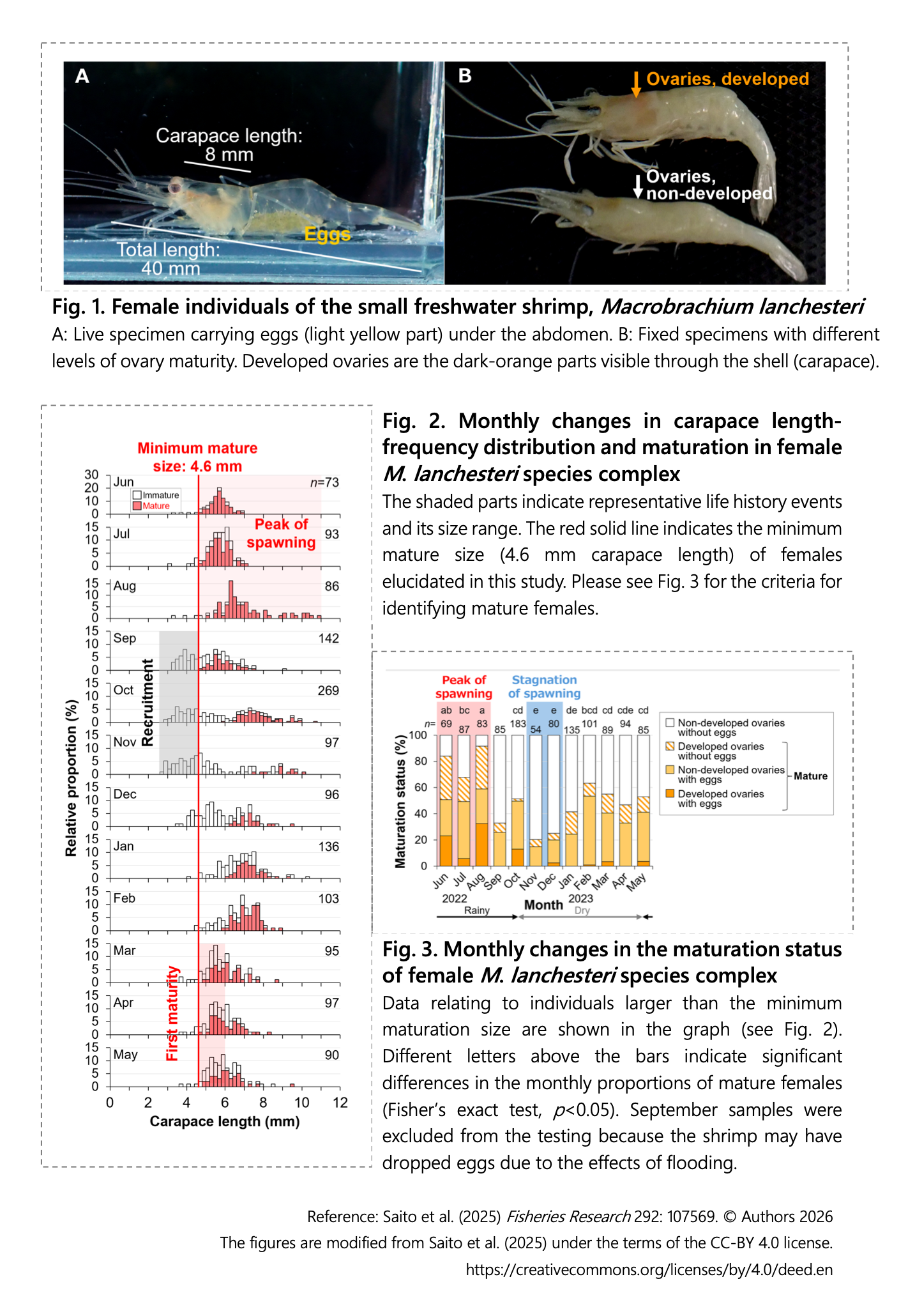
Lanchester’s Freshwater Prawn Macrobrachium lanchesteri species complex (Fig. 1) is an important freshwater crustacean resource in the inland Indochinese Peninsula, comparable to the Giant Freshwater Prawn (M. rosenbergii and M. dacqueti). Its sustainable use requires scientific information on life history, including when it spawns and how long it takes for individuals to become available to fisheries. While maturation and spawning of this species have been studied in the Ayeyarwady River System, central Myanmar, and Northern Thailand, no information was available on its recruitment and growth. In this study, specimens were collected monthly over one year from an oxbow lake in Ubon Ratchathani Province, Northeast Thailand, where shrimp fisheries operate year-round. The specimens were analyzed for individual size and maturity status to elucidate their growth, maturation, spawning, and recruitment to the fishery stock. Fisheries management practices were explored based on the life history findings to ensure sustainable use of this shrimp stock. This shrimp is a purely freshwater species that does not migrate long distances from their habitat.
The smallest mature female (carrying eggs under the abdomen (Fig. 1A) or having developed ovaries (Fig. 1B)) collected in this study was 4.6 mm in carapace length (red solid line in Fig. 2). While the species complex spawns year-round, peak spawning occurs during mid-rainy season from June to August (red shading in Fig. 3), and spawning stagnates during the dry season from November to December (blue shading in Fig. 3). Hatched shrimp begin appearing in catches as small immature individuals from September to November (recruitment; gray shading in Fig. 2), and they mature and spawn in less than a year after hatching, between March and May of the following year (red shading at the bottom of Fig. 2). The no-fishing period regulating commercial fisheries of all aquatic animals (artisanal fisheries excluded) in the region coincides with the spawning peak of the shrimp, confirming the effectiveness of this regulation in conserving adult shrimp. Furthermore, since small immature shrimp begin joining fisheries stocks around September and mature by the following rainy season, avoiding their capture during this period is suggested as an additional effective resource management strategy.
Life history information, including peak spawning period, size range and period of major recruitment to the fisheries stock, and duration until maturation, helps design effective management measures for sustainable use of small freshwater shrimp resources in the inland Indochinese Peninsula. Juvenile recruits may be conserved through mesh size regulations and shelter conservation, in addition to reducing total fishing pressure.
Figure, table
- Research project
- Program name
- Term of research
-
FY2022-2025
- Responsible researcher
-
Saito Minoru ( Fisheries Division )
ORCID ID0000-0002-8496-3562KAKEN Researcher No.: 20869474Honda Satoshi ( Fisheries Division )
Grudpan Chaiwut ( Ubon Ratchathani University )
ORCID ID0009-0000-3612-6850Grudpan Jarungjit ( Ubon Ratchathani University )
ORCID ID0009-0005-3678-4809Jutagate Achara ( Ubon Ratchathani University )
ORCID ID0009-0007-4835-3285Jutagate Tuantong ( Ubon Ratchathani University )
ORCID ID0000-0002-7179-7913 - ほか
- Publication, etc.
-
Saito et al. (2025) Fisheries Research 292: 107569https://doi.org/10.1016/j.fishres.2025.107569
- Japanese PDF
-
2025_B06_ja.pdf943.98 KB
- English PDF
-
2025_B06_en.pdf2.63 MB
* Affiliation at the time of implementation of the study.