



Regional environmental adaptability of teak genetic resources based on genomic analysis and utilization strategies under climate change
Country
Indonesia
Description
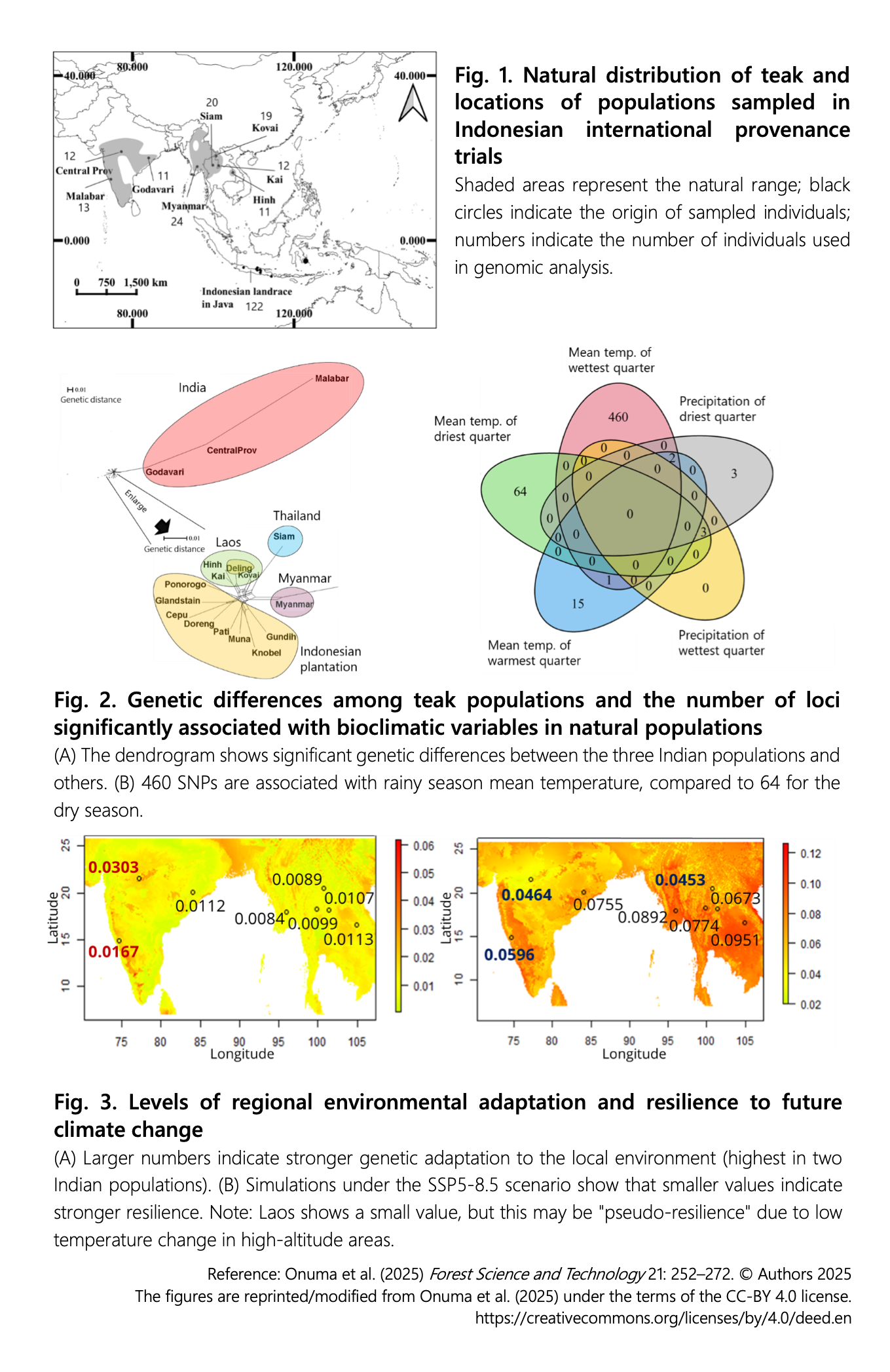
As global temperatures rise and rainfall patterns shift, forest ecosystems—and specifically long-lived trees—face a critical challenge, as they cannot simply relocate to more favorable climates. For a high-economic-value species like teak (Tectona grandis), which is used for high-end furniture production across approximately 65 countries, building resilience into plantation strategies is no longer optional but essential. In Indonesia, teak has been a staple of the timber industry for generations, yet there is an unresolved question regarding its heritage; while it was once thought to be of Indian origin, a recent study reveals that these trees are more genetically related to Indochinese populations. This research seeks to bridge that gap by using genomic data to decode the relationship between genetic diversity and climate adaptability, with the goal of future-proofing Indonesian plantations for long-term, sustainable wood production.
The study's genomic analysis reveals that populations in India harbor significantly higher genetic variation than those in other regions, with the Malabar group in southern India showing the most distinct genetic differentiation. A key discovery from the association analysis between genetic markers and climate factors is that temperature—specifically the mean temperature during the rainy season—is a far more significant evolutionary driver for teak than rainfall. These results point to a high number of genomic regions linked to thermal shifts, suggesting that the Malabar and North Indian populations possess a natural resilience to heat. This is particularly relevant for the future of Indonesian forestry, as climate models predict that the future environment of Java will resemble that of the Malabar region, making those southern Indian genetic resources ideal candidates for climate adaptation.
These findings provide a robust scientific framework for selecting tree provenances and managing genetic resources in a warming world. By strategically introducing genetic variants from the Malabar population through seed migration or targeted crossbreeding, forestry managers can effectively "upgrade" Indonesian plantations to withstand predicted climate shifts. However, the introduction of these genetic lineages requires a cautious, phased approach. It is vital to conduct long-term evaluations to monitor potential hybridization with local populations and to ensure that genetic diversity is maintained without compromising growth characteristics or resistance to local pests and diseases.
Figure, table
- Research project
- Program name
- Term of research
-
FY2021-2025
- Responsible researcher
-
Tani Naoki ( Forestry Division )
ORCID ID0000-0001-9878-6352KAKEN Researcher No.: 90343798Onuma Yuunosuke ( University of Tsukuba )
Tsumura Yoshihiko ( University of Tsukuba )
ORCID ID0000-0002-9844-0914KAKEN Researcher No.: 20353774Prasetyo Eko ( Gadjah Mada University )
ORCID ID0000-0002-3252-1623Widiyatno ( Gadjah Mada University )
ORCID ID0000-0002-6611-5009Indrioko Sapto ( Gadjah Mada University )
ORCID ID0000-0003-1828-469XNa'iem Mohammad ( Gadjah Mada University )
- ほか
- Publication, etc.
-
Onuma et al. (2025) Forest Science and Technology 21: 353-373https://doi.org/10.1080/21580103.2025.2519469
- Japanese PDF
-
2025_A02_ja.pdf2.71 MB
- English PDF
-
2025_A02_en.pdf841.25 KB
* Affiliation at the time of implementation of the study.