



Technical manual for mitigating soil salinization with preferential shallow sub-surface drainage and sub-surface irrigation
Related Research Project
Sustainable land management in drylands
Country
India
Description
In the Indo-Gangetic Plain (IGP) of northern India, soil salinization is a serious problem due to irrigation using high-salinity groundwater and residual salt accumulation resulting from poor drainage. While improving drainage and adopting water-saving practices are effective countermeasures, the construction of open drainage and sub-surface drainage networks and the introduction of drip or sprinkler systems require significant initial investment and maintenance costs. Shallow sub-surface drainage using a "Cut-soiler" (a tractor attachment developed in Japan), sub-surface irrigation using "water drop tubes," and water-saving gains through improvements in furrow irrigation are relatively inexpensive and easy to implement compared to conventional drainage and water-saving technologies. These promising and sustainable measures, which can be integrated into farming, have been compiled into a technical manual to promote extension activities.
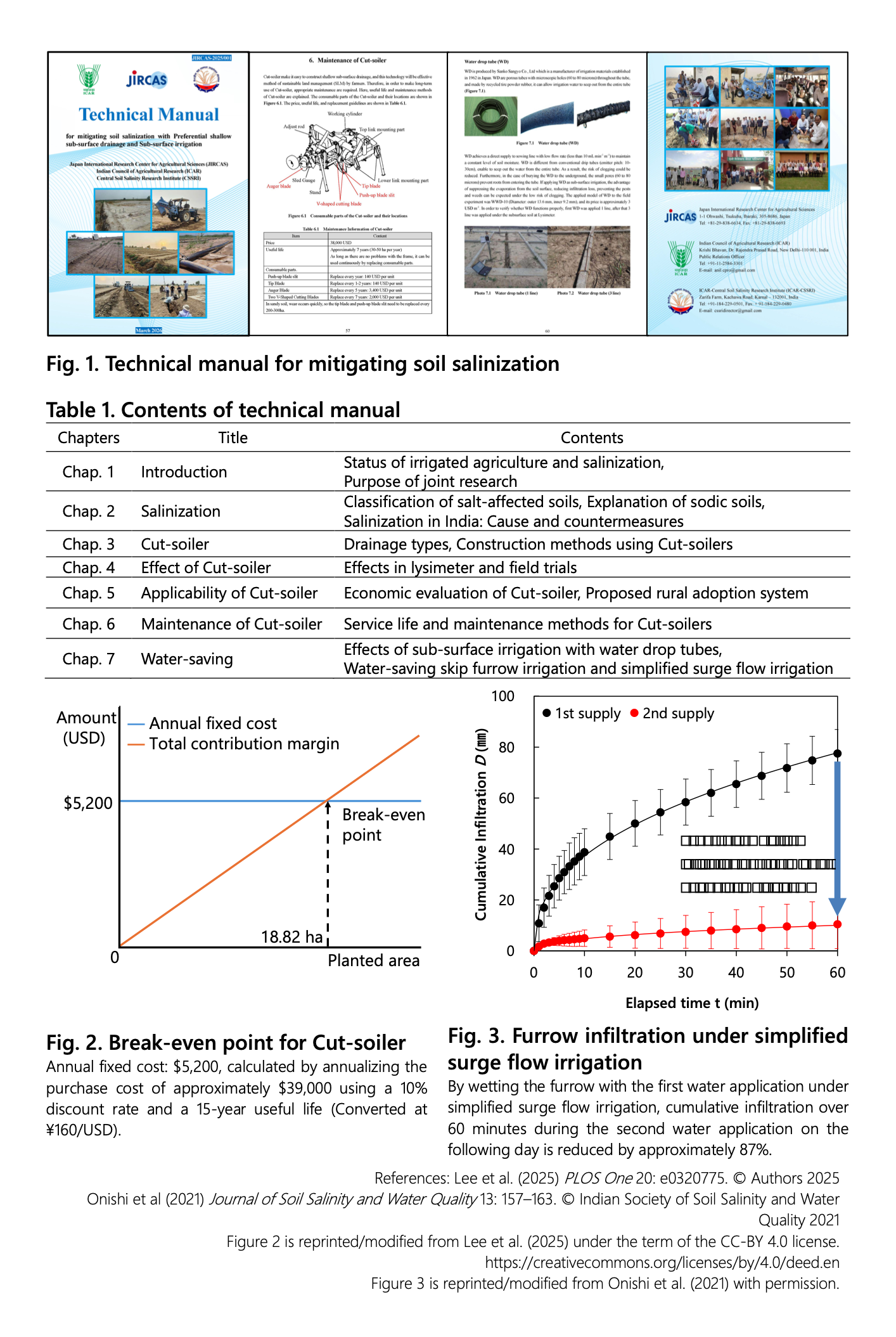
The technical manual, structured into four chapters (Table 1; Fig. 1), is an 80-page, A4-sized booklet that makes extensive use of photographs and illustrations to facilitate understanding. Regarding drainage mitigation, the manual details the structure and construction method of shallow sub-surface drainage with the Cut-soiler, alongside the effects on desalination and pH improvement. It also identifies the optimal construction interval (JIRCAS Research Highlights, FY2022 A11 and FY2024 A10). Furthermore, the manual analyzes seasonal fluctuations in groundwater levels, which share a strong causal relationship with soil salinization, to indicate the optimal construction timing for Cut-soiler drainage. The Cut-soiler’s break-even point is clarified (Fig. 2) and a rural adoption system is proposed. As water-saving measures, sub-surface irrigation with water drop tubes, skip furrow irrigation (irrigating every other furrow), and simplified surge flow irrigation (supplying water twice at a one-day interval) (Fig. 3) are introduced. Additionally, the manual identifies soil sodification (an increased proportion of sodium ions) as a primary cause of serious drainage problems and proposes relevant countermeasures.
The technical manual can be used in trainings and/or seminars for widespread dissemination of the effects of shallow sub-surface drainage and sub-surface irrigation. The distribution of the manual is expected to facilitate rapid information sharing among government officials, local organizations, and farmers. While shallow sub-surface drainage and sub-surface irrigation are distinct technologies, if applied together, a greater effect is expected. Although the manual is based on verification within the IGP, it is applicable to similar regions based on an evaluation of irrigation and drainage conditions.
Figure, table
- Research project
- Program name
- Term of research
-
FY2018-2025
- Responsible researcher
-
Chaudhari Suresh Kumar ( Fertilizer Association of India )
Yadav Rajender Kumar ( Central Soil Salinity Research Institute )
ORCID ID0000-0003-1436-2072Yadav Gajender ( Central Soil Salinity Research Institute )
Rai Arvind Kumar ( Central Soil Salinity Research Institute )
Kumar Suresh ( Central Soil Salinity Research Institute )
Kumar Satendra ( Central Soil Salinity Research Institute )
Narjary Bhaskar ( Central Soil Salinity Research Institute )
ORCID ID0000-0002-3148-2204Onishi Junya ( Rural Development Division )
Kameoka Taishin ( Rural Development Division )
Matsui Kayo ( Rural Development Division )
KAKEN Researcher No.: 10814189Lee Guenwoo ( Social Sciences Division )
ORCID ID0000-0001-5623-6205KAKEN Researcher No.: 80836643Kitagawa Iwao ( Institute for Rural Engineering, NARO )
- ほか
- Publication, etc.
-
Lee G et al (2025) Plos Onehttps://doi.org/10.1371/journal.pone.0320775Gajender Y et al. (2024) Journal of Arid Land Studies 34(S), 21-24https://doi.org/10.14976/jals.34.S_21Rajender KY et al. (2024) Journal of Arid Land Studies 34(S), 29-32https://doi.org/10.14976/jals.34.S_29Matsui K and Onishi J (2024) Journal of Arid Land Studies 34(S), 75-78https://doi.org/10.14976/jals.34.S_75Neha et al. (2024) Journal of Arid Land Studies 34(S), 17-20https://doi.org/10.14976/jals.34.S_17Onishi et al. (2023) Journal of the Japanese Society of Irrigation, Drainage and Rural Engineering 91(2): 83-86Onishi et al (2021) Journal of Soil Salinity and Water Quality 13(2), 157-163
- Japanese PDF
-
2025_A05_ja.pdf2.56 MB
- English PDF
-
2025_A05_en.pdf2.16 MB
* Affiliation at the time of implementation of the study.