


Soybean Yield Response to Liming Materials in Paddy-Upland Rotation Fields
Japan Agricultural Research Quarterly
| ISSN | 00213551 |
|---|---|
| NII recode ID (NCID) | AA0068709X |
Full text
jarq60-4_299-306.pdf820.23 KB
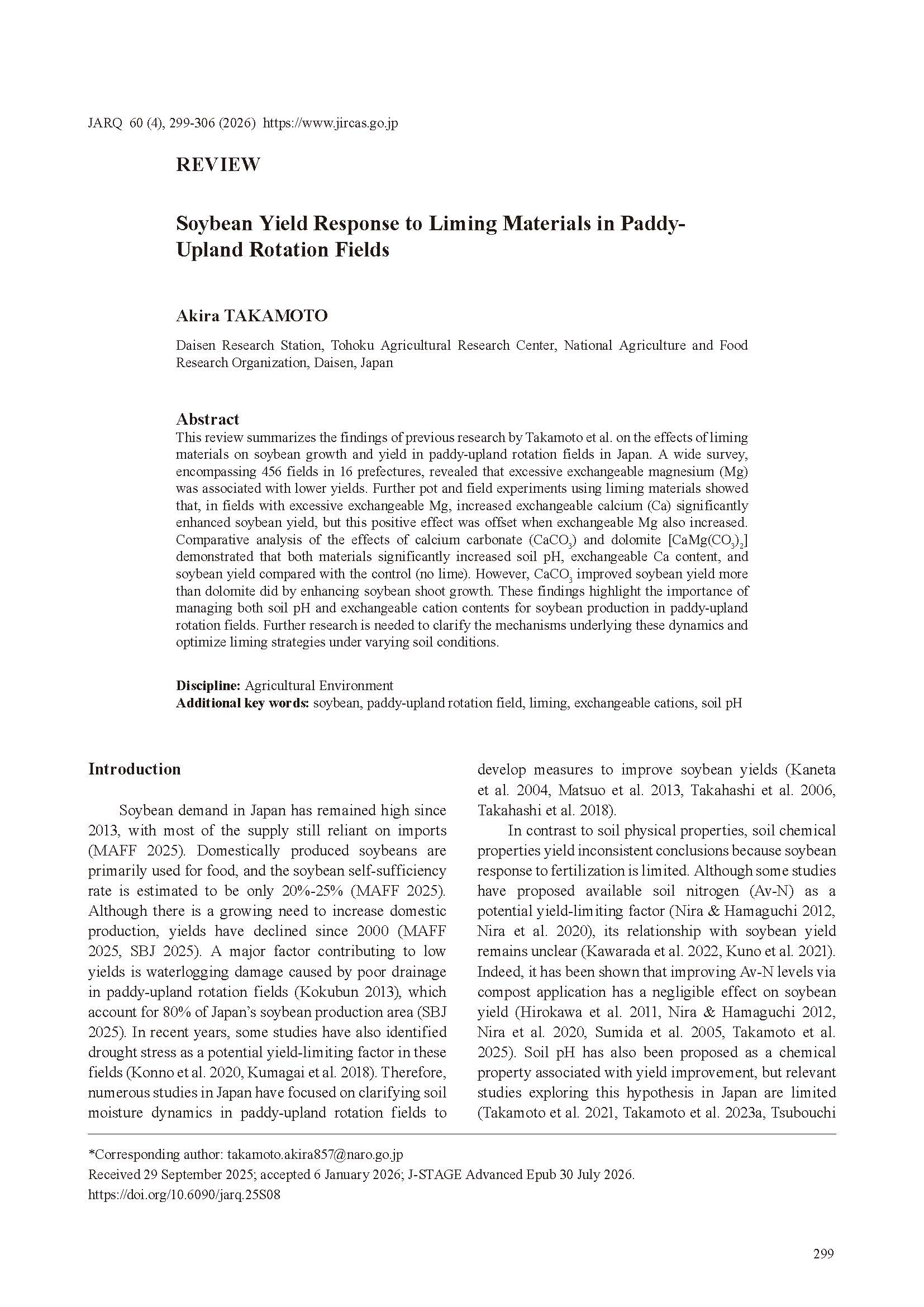
This review summarizes the findings of previous research by Takamoto et al. on the effects of liming materials on soybean growth and yield in paddy-upland rotation fields in Japan. A wide survey, encompassing 456 fields in 16 prefectures, revealed that excessive exchangeable magnesium (Mg) was associated with lower yields. Further pot and field experiments using liming materials showed that, in fields with excessive exchangeable Mg, increased exchangeable calcium (Ca) significantly enhanced soybean yield, but this positive effect was offset when exchangeable Mg also increased. Comparative analysis of the effects of calcium carbonate (CaCO3) and dolomite [CaMg(CO3)2] demonstrated that both materials significantly increased soil pH, exchangeable Ca content, and soybean yield compared with the control (no lime). However, CaCO3 improved soybean yield more than dolomite did by enhancing soybean shoot growth. These findings highlight the importance of managing both soil pH and exchangeable cation contents for soybean production in paddy-upland rotation fields. Further research is needed to clarify the mechanisms underlying these dynamics and optimize liming strategies under varying soil conditions.
| Date of issued | |
|---|---|
| Creator | Akira TAKAMOTO |
| Subject | soybean paddy-upland rotation field liming exchangeable cations soil pH |
| Publisher | Japan International Research Center for Agricultural Sciences |
| Received Date | 2025-09-25 |
| Accepted Date | 2026-01-06 |
| Available Online | |
| NII resource type vocabulary | Journal Article |
| Volume | 60 |
| Issue | 4 |
| spage | 299 |
| epage | 306 |
| DOI | 10.6090/jarq.25S08 |
| Language | eng |