



Comparing Symptoms and Virus Accumulation of Three Tobamoviruses in Cucurbitaceae Hosts
Japan Agricultural Research Quarterly
| ISSN | 00213551 |
|---|---|
| NII recode ID (NCID) | AA0068709X |
Full text
jarq60-1_49-59.pdf1.53 MB
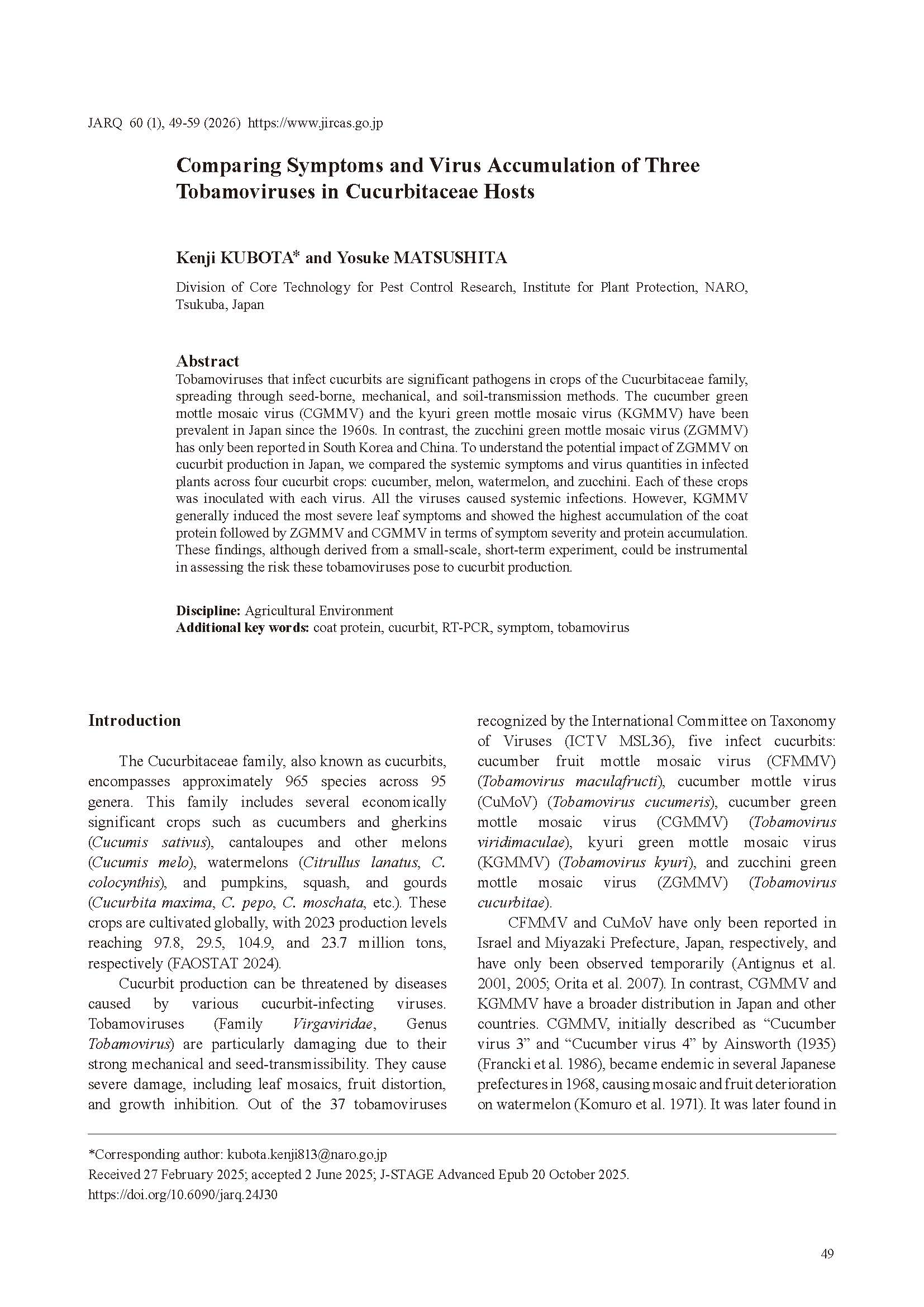
Tobamoviruses that infect cucurbits are significant pathogens in crops of the Cucurbitaceae family, spreading through seed-borne, mechanical, and soil-transmission methods. The cucumber green mottle mosaic virus (CGMMV) and the kyuri green mottle mosaic virus (KGMMV) have been prevalent in Japan since the 1960s. In contrast, the zucchini green mottle mosaic virus (ZGMMV) has only been reported in South Korea and China. To understand the potential impact of ZGMMV on cucurbit production in Japan, we compared the systemic symptoms and virus quantities in infected plants across four cucurbit crops: cucumber, melon, watermelon, and zucchini. Each of these crops was inoculated with each virus. All the viruses caused systemic infections. However, KGMMV generally induced the most severe leaf symptoms and showed the highest accumulation of the coat protein followed by ZGMMV and CGMMV in terms of symptom severity and protein accumulation. These findings, although derived from a small-scale, short-term experiment, could be instrumental in assessing the risk these tobamoviruses pose to cucurbit production.
| Date of issued | |
|---|---|
| Creator | Kenji KUBOTA Yosuke MATSUSHITA |
| Subject | coat protein cucurbit RT-PCR symptom tobamovirus |
| Publisher | Japan International Research Center for Agricultural Sciences |
| Received Date | 2025-02-27 |
| Accepted Date | 2025-06-02 |
| Available Online | |
| Volume | 60 |
| Issue | 1 |
| spage | 49 |
| epage | 59 |
| DOI | 10.6090/jarq.24J30 |
| Language | eng |