



Calculating Fuel Efficiency for Head-Feeding Combine Harvesters
Japan Agricultural Research Quarterly
| ISSN | 00213551 |
|---|---|
| NII recode ID (NCID) | AA0068709X |
Full text
jarq60-1_61-72.pdf2.15 MB
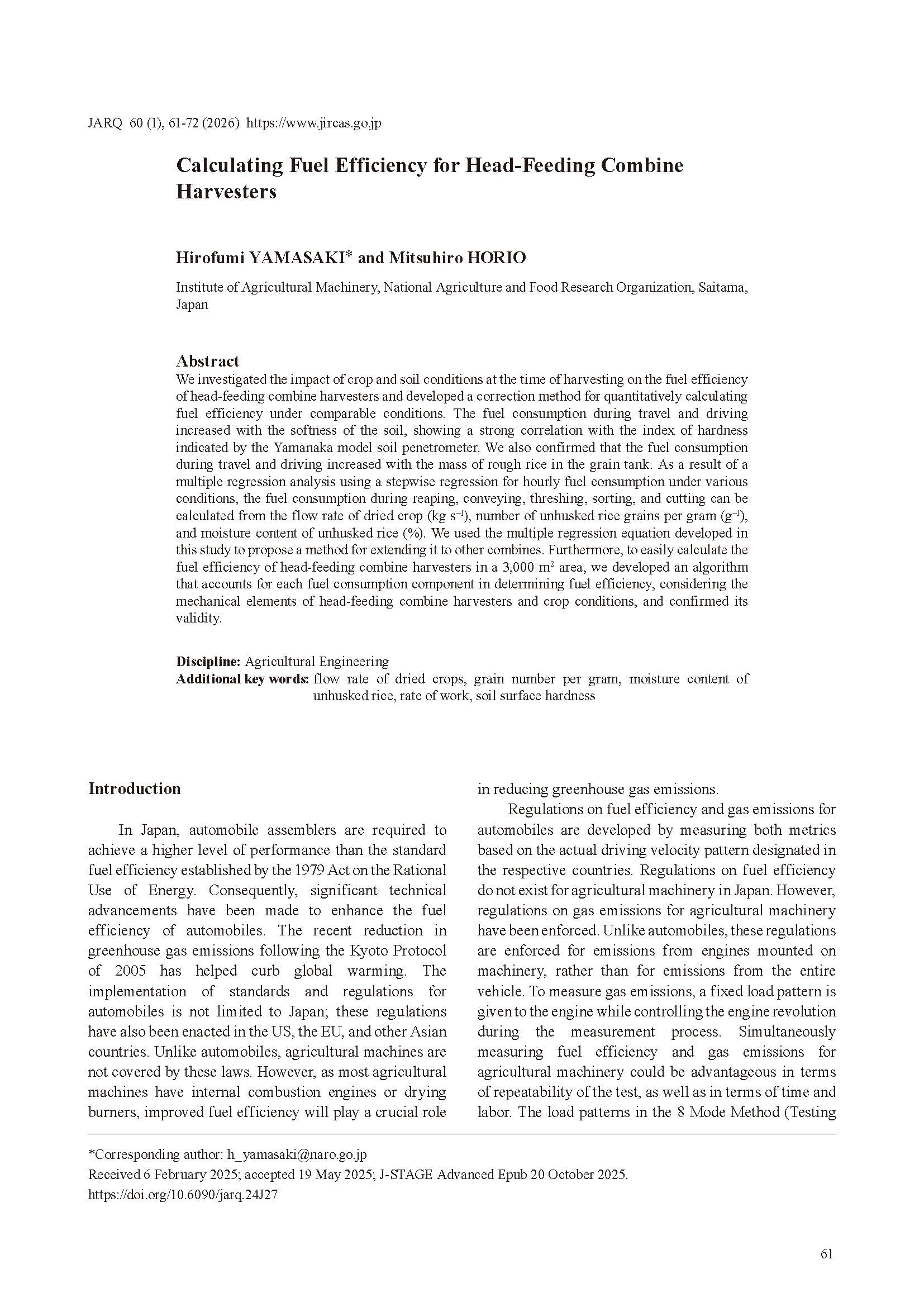
We investigated the impact of crop and soil conditions at the time of harvesting on the fuel efficiency of head-feeding combine harvesters and developed a correction method for quantitatively calculating fuel efficiency under comparable conditions. The fuel consumption during travel and driving increased with the softness of the soil, showing a strong correlation with the index of hardness indicated by the Yamanaka model soil penetrometer. We also confirmed that the fuel consumption during travel and driving increased with the mass of rough rice in the grain tank. As a result of a multiple regression analysis using a stepwise regression for hourly fuel consumption under various conditions, the fuel consumption during reaping, conveying, threshing, sorting, and cutting can be calculated from the flow rate of dried crop (kg s–1), number of unhusked rice grains per gram (g–1), and moisture content of unhusked rice (%). We used the multiple regression equation developed in this study to propose a method for extending it to other combines. Furthermore, to easily calculate the fuel efficiency of head-feeding combine harvesters in a 3,000 m2 area, we developed an algorithm that accounts for each fuel consumption component in determining fuel efficiency, considering the mechanical elements of head-feeding combine harvesters and crop conditions, and confirmed its validity.
| Date of issued | |
|---|---|
| Creator | Hirofumi YAMASAKI Mitsuhiro HORIO |
| Subject | flow rate of dried crops grain number per gram moisture content of unhusked rice rate of work soil surface hardness |
| Publisher | Japan International Research Center for Agricultural Sciences |
| Received Date | 2025-02-06 |
| Accepted Date | 2025-05-19 |
| Available Online | |
| Volume | 60 |
| Issue | 1 |
| spage | 61 |
| epage | 72 |
| DOI | 10.6090/jarq.24J27 |
| Language | eng |